Now that you know what a sextant is, how to use it, and the angles it gives us, we now need to learn how to calculate the latitude and longitude from these
measurements.
Finding Latitude
Observe the Sun in the sky
When the Sun reaches it's highest point, find the angle it is at with the Sextant (local noon)
Use a nautical almanac to figure out how north or south of the equator you are (declination)
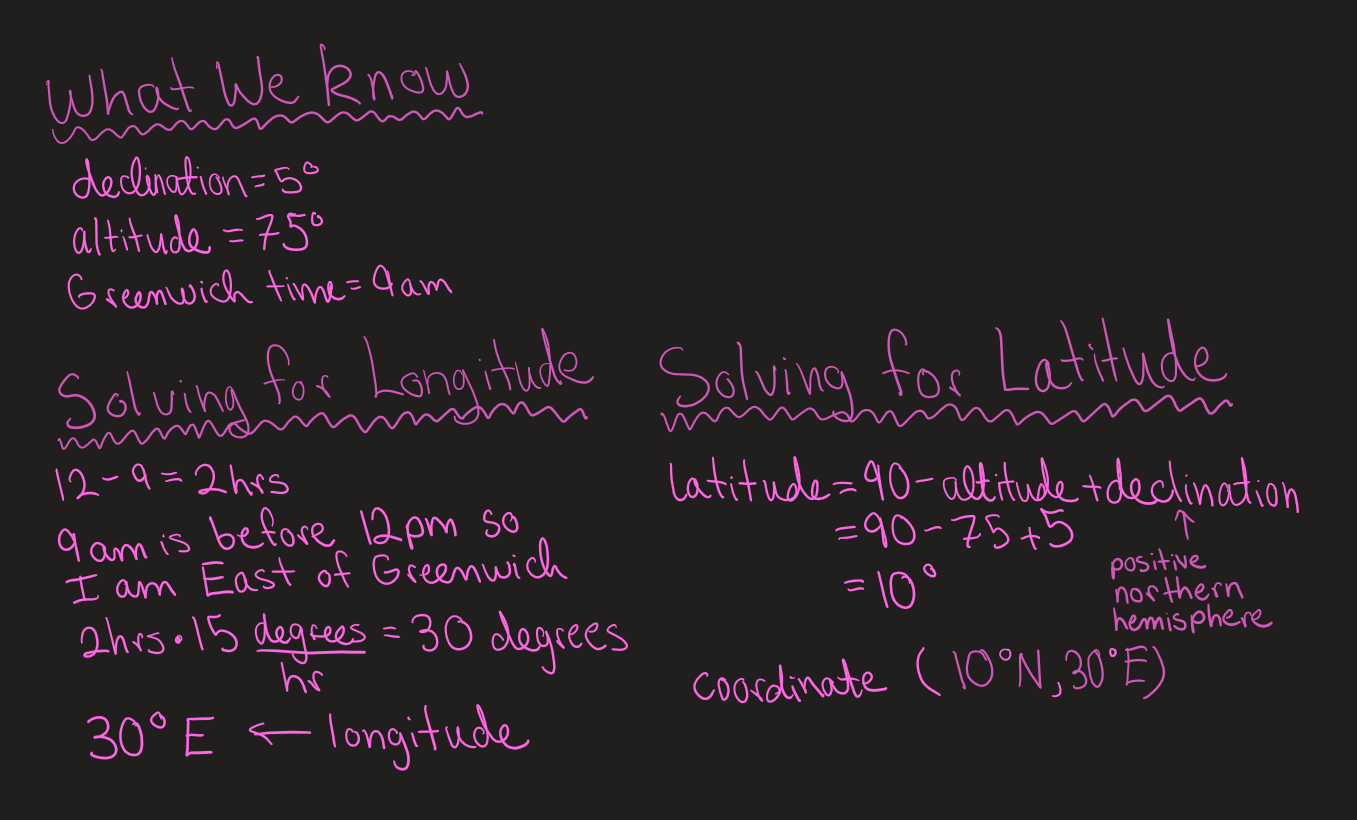
Put it together: Latitude = 90 degrees - altitude + declination
Finding Longitude
The one day is 24 hours and a 360 degree rotation. Using this information, we can see that in one hour, the Earth has rotated 15 degrees.
This information will help us find the longitude.
Observe the Sun in the sky
When the Sun reaches it's highest point, find the angle it is at with the Sextant (local noon)
Record the time it is in Greenwich, England when you found local noon
if local noon before Greenwich noon --> you are east of Greenwich
if local noon after Greenwich noon --> you are west of Greenwich
However many hours different you are from Greenwich time of noon, multiply that number of hours by 15 degrees
This gives you either West or East and by how much of Greenwich, England which is the meridian
Example Problem
When you observe the local noon, you find the altitude to be 75 degrees and the time in Greenwich is 9:00 AM. You reference the nautical almanac and find
that the declination of the Sun today is 5 degrees. Using this information, find your latitude and longitude. To check your work, scroll below the picture.
This interactive model allows you to explore the different angles and relationships that go into the calculation of the longitude of a ship.
Try zooming in or out to get a closer look at these relationships or try clicking on the "Play day" button to watch as the angles change throughout the day.
The End of a Problem
Now that they had successfully solved the Longitude problem, with the help of a sextant and a chromometer,
there were fewer deaths at sea. With all the current technological developments, there is a lower demand for knowledge and
proficiency in using a sextant. These skills are, however, more crucial than ever in preventing a great loss of life when technology fails
and we have to rely on our surroundings and the math around us.