Double Reflection Principle
Sextants use a very powerful princple called the double reflection principle. This principle uses the angles of rays reflecting off a mirror.
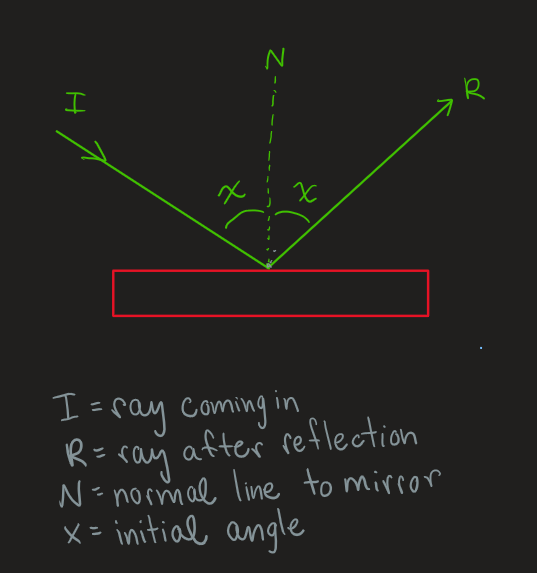
As you can see in the figure above, an incoming ray (I) goes forwards and hits a mirror. This mirror then reflects the ray (R). From the mirror, we can draw a perpendicular line (N). The angle on either sides of N (x) is the same.
Now we will use this information to explain the double reflection principle.
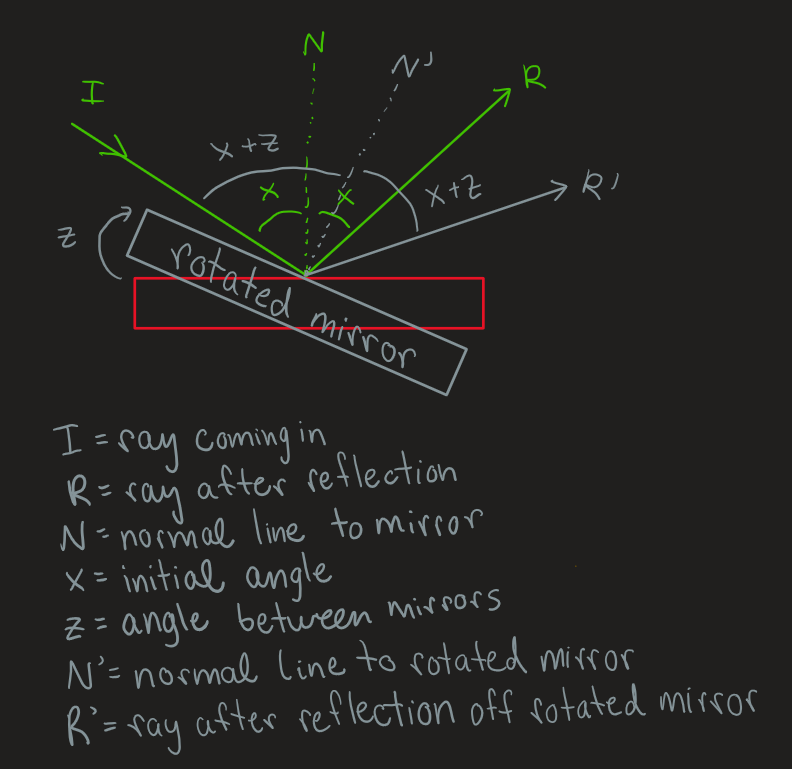
The figure above, we see two mirrors. The first mirror is the same, but there is also a grey mirror with its corresponding angles in grey as well. The grey mirror is exactly the same as the first mirror, but it has been rotated by an angle of z. I is the same as before, the ray is still coming from the same direction. R is now R', and N is now N'. N' is the normal line to the grey mirror. The new angle between N' and I is x+z. This makes sense becasue we just shifted x by z degrees. The angle between N and N' is z. Now we want to look at the angles between N and R'.
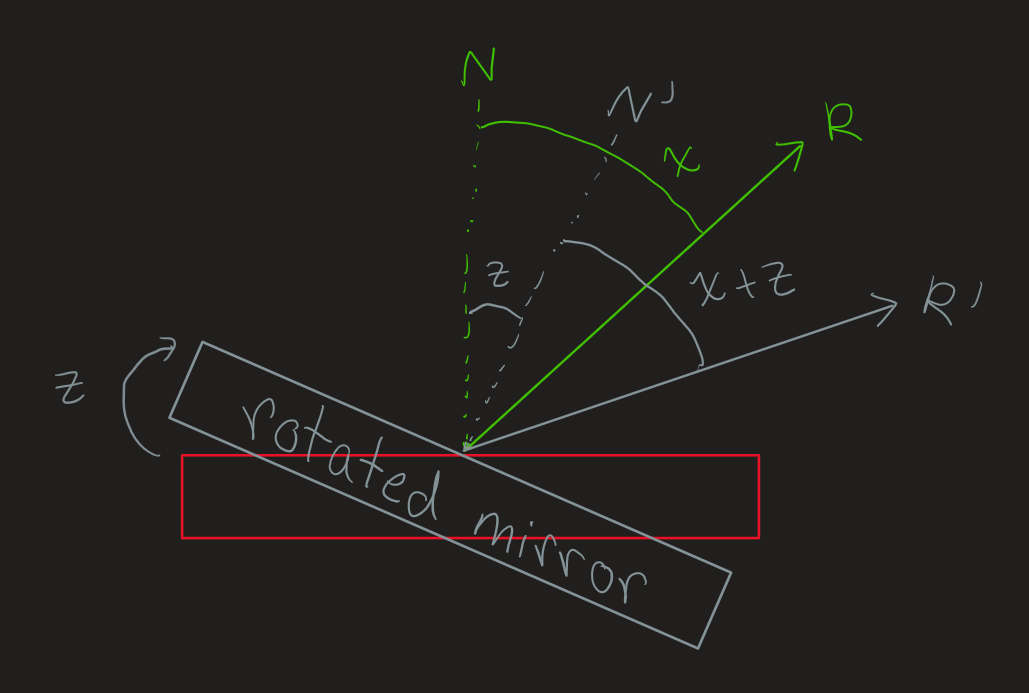
As we said before, the angle between N and R' is x. We also said that the angle between N and N' is z. Using this information, we can find the angle between N' and R to be x-z.
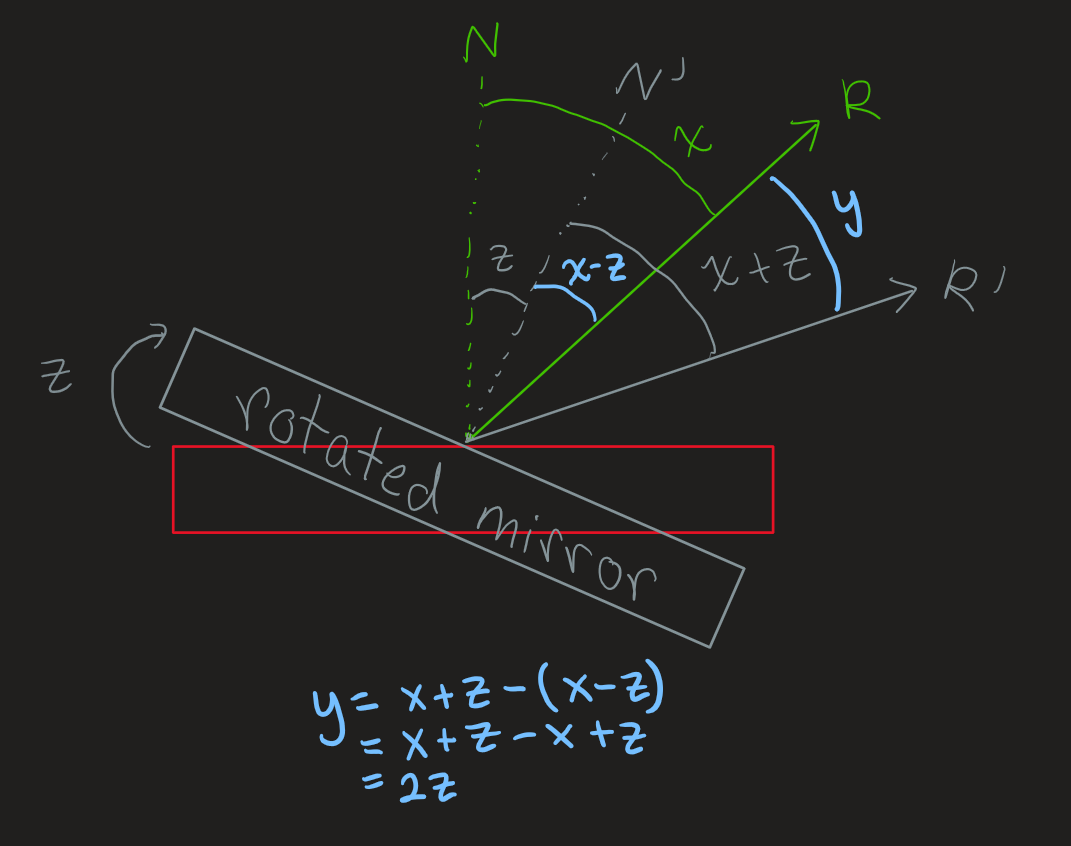
Now that we know the angle between N' and R is x-z and we know the angle between N' and R' is x+z, we can use this to find the angle between R and R'. The angle between R and R' (y) is going to be the angle between N' and R' minus the angle between N' and R.
y = (x+z) - (x-z) = 2z.
This means that the angle between R and R' is double the angle of rotation of the mirror.
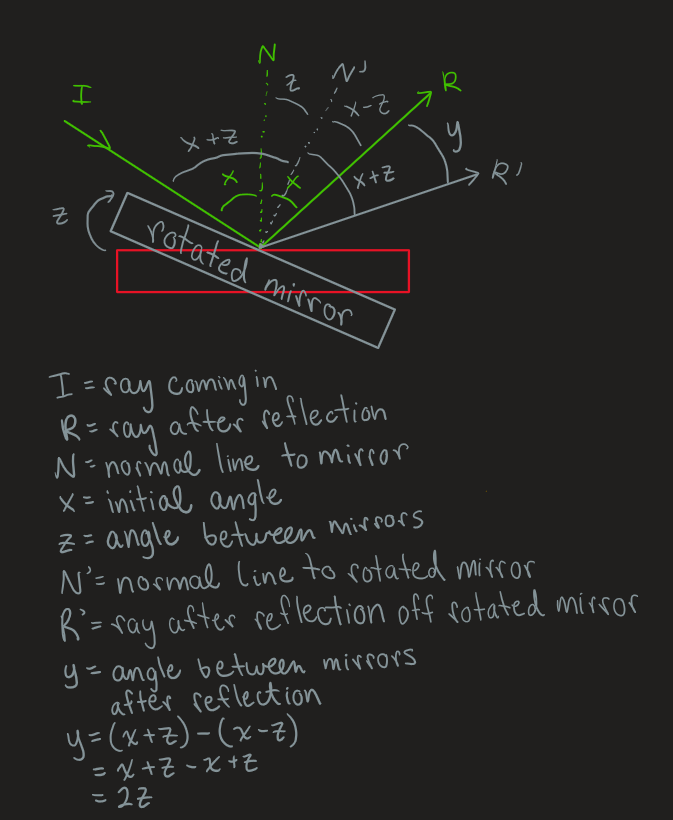
The figure above summarizes the double reflection principle in one drawing.
This principle is used in the design of the sextant because even though the sextant is only 60 degrees, it can measure angles up to 120 degrees. That means something that is relatively small, can measure angles that are double its size, making it easier to move and use. Imagine trying to hold a 120 degree instrument while measuring the angle of the sun. It would be very awkward.