To understand the math behind Spot It! we need to first understand what finite projective planes are. A projective plane is a type of geometric structure that satisfies three axioms;
In order for a projective plane to be finite it must have a countable number of points and lines. If each line contains n+1 points, we call it an n-order plane. In a finite plane the following relationships hold;
Lets consider the smaller finite projective plane where n=2. This is called the Fano Plane. Looking at the above relationships we can see that there will be 7 points, 7 lines, every line will have 3 points, and every point will lie on 3 lines. The applet shows the Fano Plane. Looking at the image lets imagine that each point is a card and each line represents a symbol that is on the card. If a card is on a line, it contains the symbol the line represents. This means each card will have three symbols on it. Since there are 7 lines, there are 7 symbols. In the applet example of the Fano Plane there are cards at the bottom that contain symbols that are letters. Drag the cards onto the Fano Plane in a way that assigns each line a symbol. If you do it correctly all of the same letters should be on one line. There are many ways to do this. Click the “Correct Example” button to see one correct possibility.
Consider the correct example. Notice that all the points on the same line, contain the same symbol. Also note that each card only has one matching letter with every other card. This is very essential to how Spot It! was created. Because of the way a finite projective plane is structured, we can use it in this way to make cards that only have one matching symbol between each card.
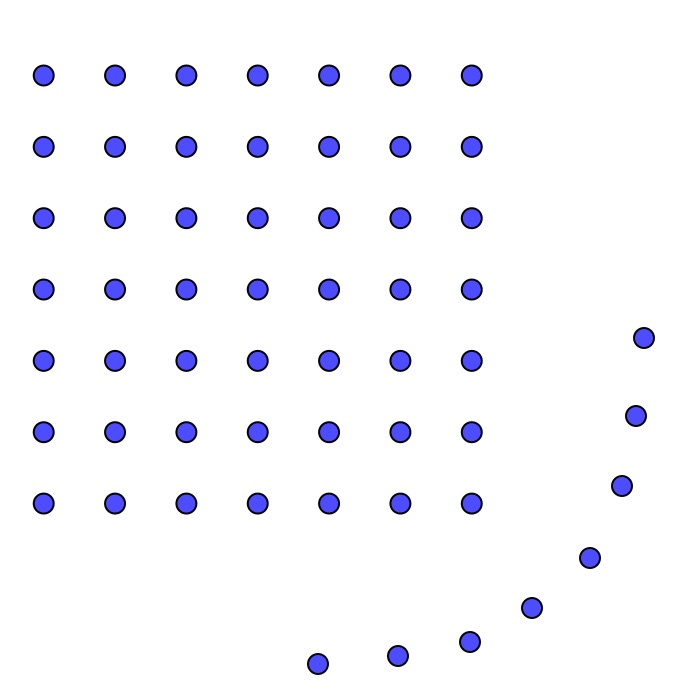
To fully understand how Spot It! was created using finite projective planes we need to look at a finite projective plane that is of 7th order. Meaning in this case n=7. When n= 7 we know that there are going to be 57 points, 57 lines, each point will lie on 8 lines, and each line will have 8 points on it. Something to note at this point is that when dealing with finite projective planes, there is no such thing as parallel lines. This means that two lines will always intersect at a point. When two lines appear parallel we say that they intersect at a “vanishing point” that is infinitely far away. We will need to include our vanishing points when we create our 7th order projective plane. The image below shows the points of a 7th order projective plane, including the vanishing points. We can see that this projective plane is laid out in a 7x7 grid with the vanishing points on the bottom right side. Remember that these points represent cards.
We will now draw lines through our points. Remember that our lines represent a unique symbol and this symbol is on every card that lies on the line. We will draw lines in every possible direction from the first point. For example, we will draw lines that are in the horizontal direction as show in the picture below.
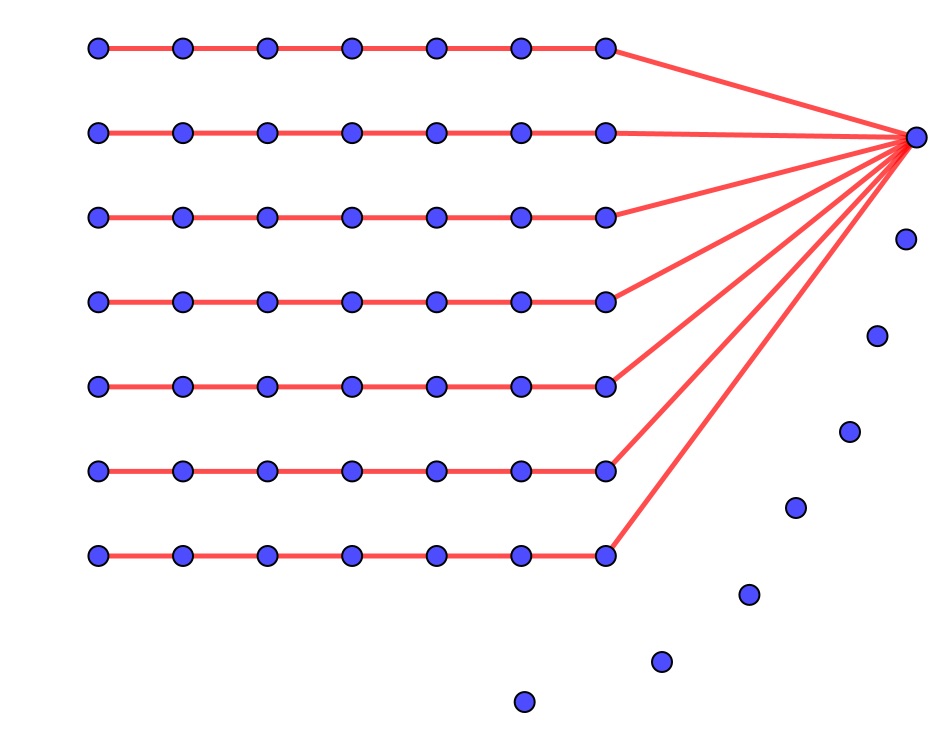
Remember that each line represents a symbol. This means that all the cards on the top line share a unique symbol, all the cards on the second line share a different unique symbol from the first line, and so on. The vanishing point that goes with these horizontal lines contains all 7 symbols from the horizontal line. This card also contains the symbol of the line that goes through all of the vanishing points. This gives it a total of 8 symbols.
Every card will have 8 symbols on it because we can draw lines in 8 different directions. This is show below. There is one that includes the lines going to vanishing points and one that doesn’t just for demonstration purposes. The lines do go to the vanishing points but it makes less clear to see the different line directions.
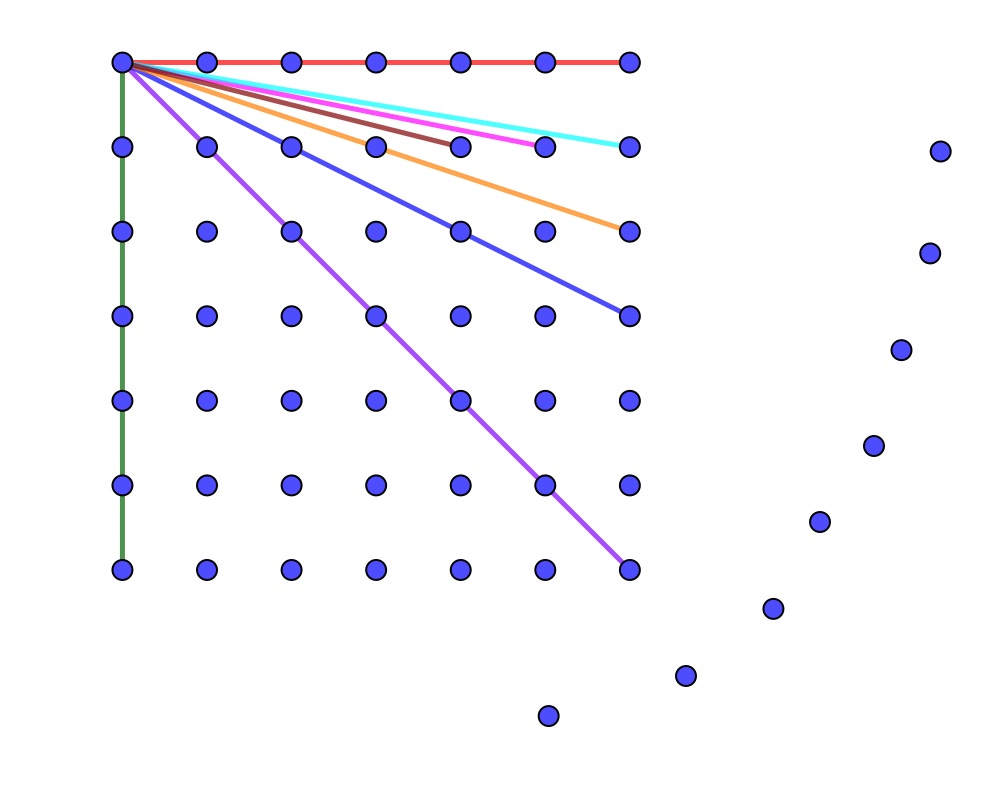
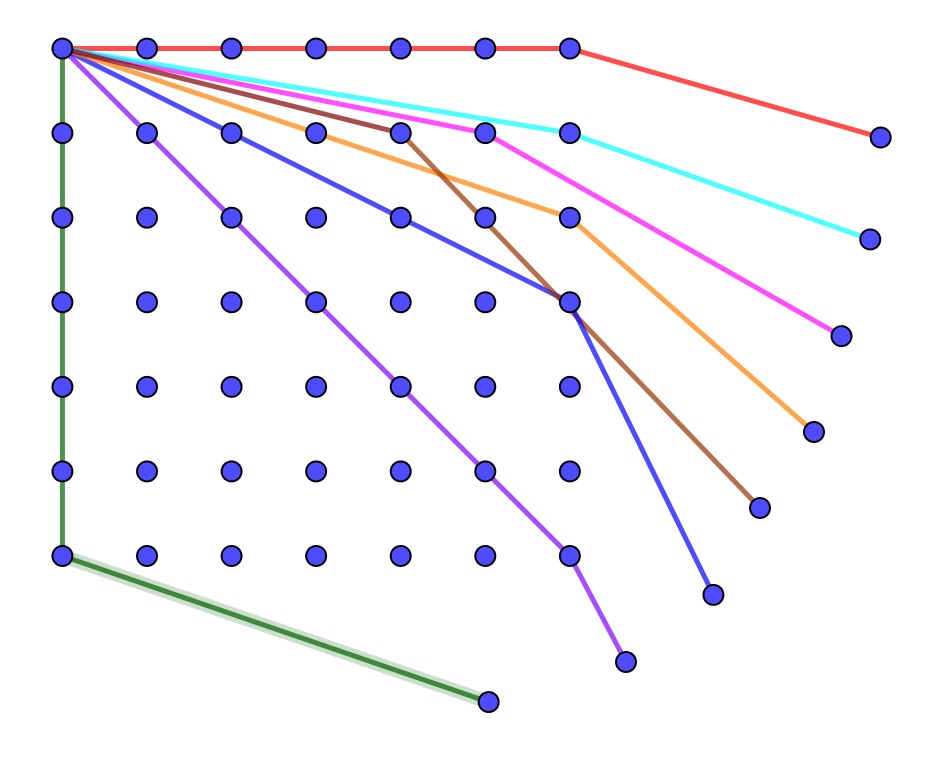
Looking at the pictures we see that from the first point we have lines with a slope of 0 (red), -1/6 (cyan), -1/5 (hot pink), -1/4 (brown), -1/3 (orange), -1/2 (blue), -1 (purple), and a vertical line straight down from the first point (green). These are the different line directions. These lines don’t just extend from the first point but go through all points. An example of this is the red horizontal lines from above. Below is the example of the diagonal purple lines.
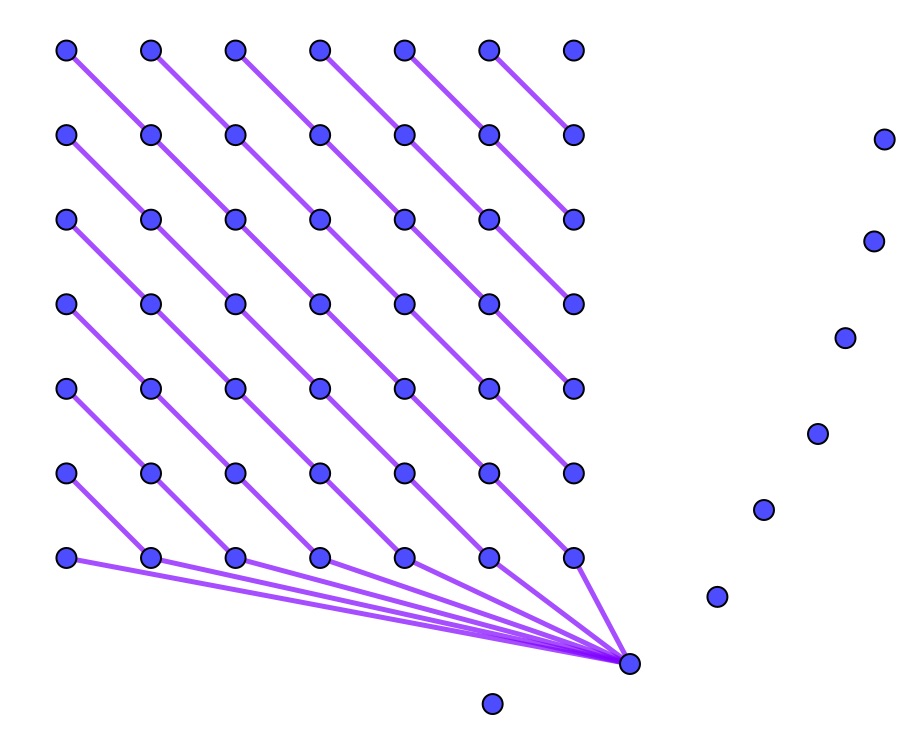
Recall that as part of the axioms for finite projective planes in this plane each line must have 8 points on it. Because of this the lines “wrap around” in our diagram. Meaning the top right point on our plane is actually on the same line as the point second to the top on the left. This “wrapping around” applies in all of our line directions that are not perfectly vertical or perfectly horizontal. This preserves our axioms.
When all of these lines are draw there is 8 lines going through each point. Meaning there are 8 symbols on each card. There is also only one line between each pair of points, this means that there is only one matching symbol between each pair of cards. This is the game Spot it!. We have demonstrated how finite projective planes were used to create the game Spot It!.
You may be asking why there are 57 points in a projective plane but only 55 cards in a deck of Spot It!. Olivia Chen from Massachusetts Institute of Technology speculates that this is because cards are produced in packs of 55 and it would cost the company extra money to add two extra cards to each deck. So two cards were just never produced. (Chen, O., & Han, N., 2024)