$\infty$ Infinity in Mathematics $\infty$
$\infty$ Significance and Applications $\infty$
Infinity and Approximations
Riemann Sums and Calculus
Concepts of infinity are central to calculus. Integrals approximate exact areas below the curve of polynomials - but this is based on infinite topics.
Integrals are based upon the idea of Riemann sums. Riemann sums are sums of the area of rectangles underneath the curve. As these the number of rectangles increase and as their widths get smaller, the approximation gets better. Thus as the number of rectangles tends to infinity, the approximation gets better. In taking a limit of the Reimann sum with the number of subdivisions approaches infinity we find an estimation for the area under the curve with diminishing error.
Try playing around with this principle in the applet below
Series and Sequences
"In mathematics, infinite series are sequences of numbers that continue indefinitely. They are used to represent functions, approximate values, and solve various mathematical problems."
By using calculus techniques of infinite series and sequences, mathematicians are able to better understand and model real-world situations correctly.
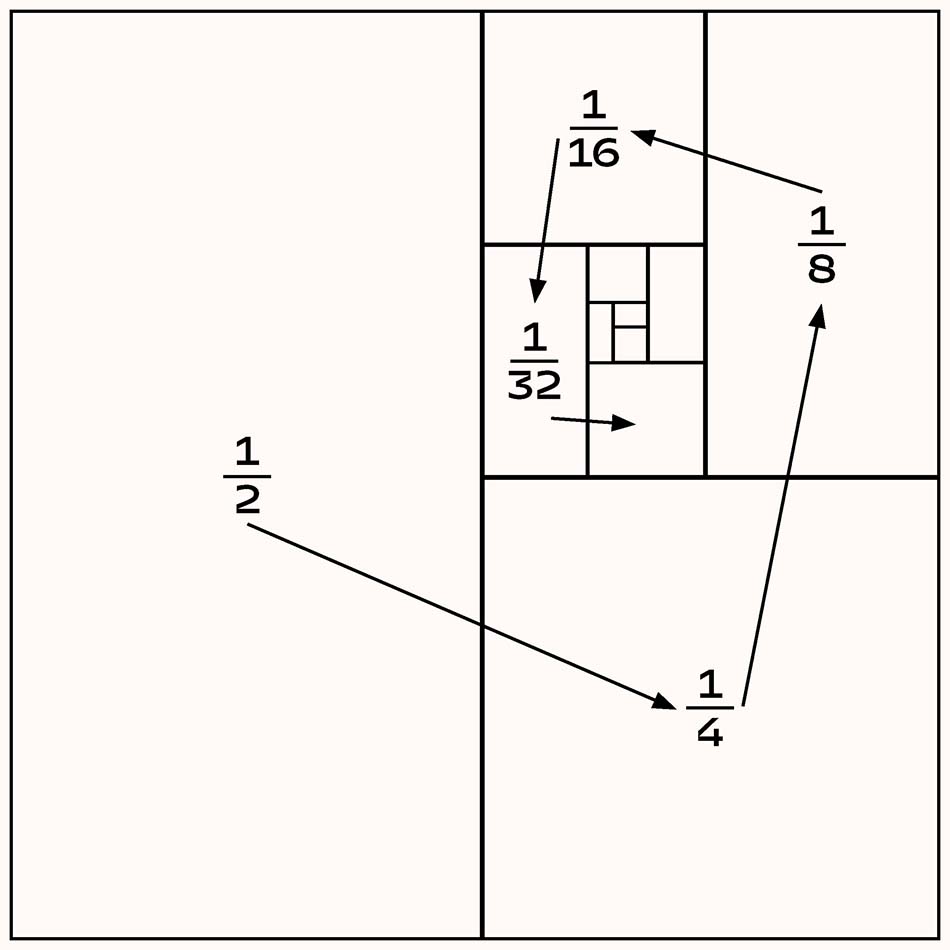
Image credit: (Henriquet, 2022)
For example, Zeno's paradoxes are resolved via infinite series, particularly a geometric series that converges to 1. This series is modeled in the image above. Luckily, the arrow will hit its target, and Acheilies will eventually catch up to the tortoise.
Additionally, expansions of the "Taylor Series" help in approximating complex functions with smaller ones, "facilitating engineering, physics, and technology applications."
(GeeksforGeeks 2024)
Infinity and Geometry
Infinity is very important in defining geometric terms. In geometry, a line continues in both directions without end, thus in geometry a line has infinite length.
Additionally, Geometric proofs rely heavily on infinity. By using infinite subdivisions and iterations, one can more accurately approximate areas of shapes, perimeter, radius, pi, and more.
In the applet below, you can see the approximation for the area of a circle can be found by inscribing a n-sided polygon in a circle. As the value of n gets larger, the area approximation gets better; thus modeling that as n approaches infinity, the approximation for the area of the circle using an n-gon gets better.
Original Applet: n-gon Approximation
Infinity and Calculus
The first textbook of differential calculus was published in 1696 by the Marquis de L'Hôpital. This textbook presented excellent definitions, postulates, and axioms laying the foundation for infinity in calculus and future analysis techniques. Some of these definitions are as follows:
Definition I. Those quantities are called variable which increase or decrease continually, as opposed to constant quantities that remain the same while others change.
Definition II. The infinitely small portion by which a variable quantity continually increases or decreases is called the Differential.
Postulate I. We suppose that two quantities that differ by an infinitely small quantity may be used interchangeably, or (what amounts to the same thing) that a quantity which is increased or decreased by another quantity that is infinitely smaller than it is, may be considered as remaining the same.
Postulate II. We suppose that a curved line may be considered as an assemblage of infinitely many straight lines, each one being infinitely small, or (what amounts to the same thing) as a polygon with an infinite number of sides, each being infinitely small, which determine the curvature of the line by the angles formed amongst themselves.
Definition II. The infinitely small portion by which a variable quantity continually increases or decreases is called the Differential.
Postulate I. We suppose that two quantities that differ by an infinitely small quantity may be used interchangeably, or (what amounts to the same thing) that a quantity which is increased or decreased by another quantity that is infinitely smaller than it is, may be considered as remaining the same.
Postulate II. We suppose that a curved line may be considered as an assemblage of infinitely many straight lines, each one being infinitely small, or (what amounts to the same thing) as a polygon with an infinite number of sides, each being infinitely small, which determine the curvature of the line by the angles formed amongst themselves.
(Oppy, Graham, et al, 2021)
Additional Applications
Concepts of infinity extend beyond the scope of set notation and pure mathematics into applied fields. Infinity is important in the fields of topology, number theory, and complex analysis.
Concepts of Infinity and repeating paterns are also used in art (mobius band, mirroring, tellestrations, etc.).
Infinity is also essential in the scope of physics as physicists study quantum mechanics, black holes, singularities, and the nature of the universe.
(Chotaliya, 2015)
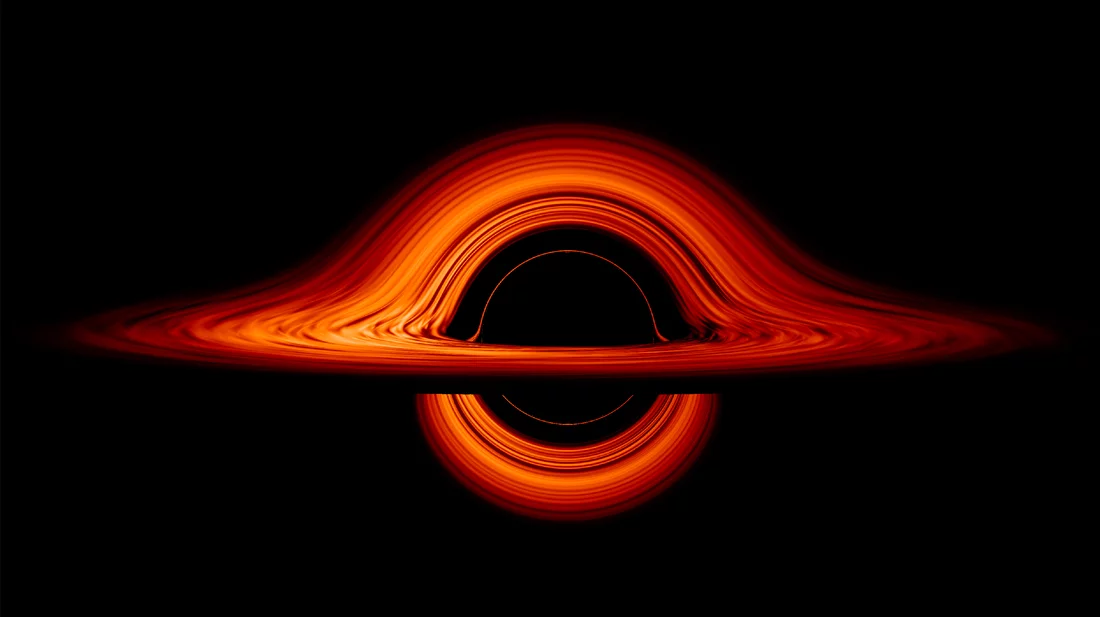
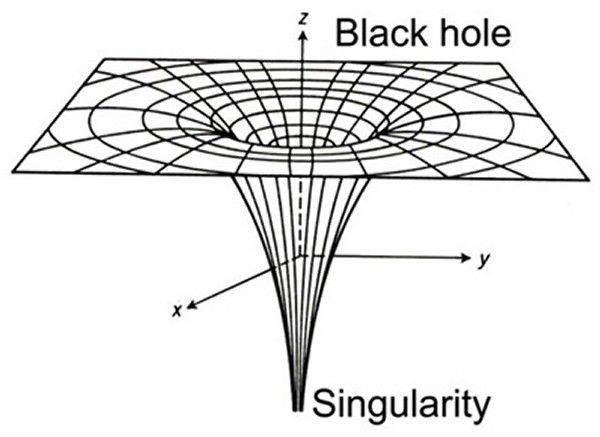
Image credits:
https://www.npr.org/2020/05/19/859158971/what-would-it-be-like-to-fall-into-a-black-hole
https://sureshemre.wordpress.com/2012/04/14/infinite-curvature-of-spacetime-singularity/
https://www.npr.org/2020/05/19/859158971/what-would-it-be-like-to-fall-into-a-black-hole
https://sureshemre.wordpress.com/2012/04/14/infinite-curvature-of-spacetime-singularity/