$\infty$ Infinity in Mathematics $\infty$
$\infty$ History and Background $\infty$
Religion, Philosophy, and Fear
When one thinks of ancient Greece, the mind is immediately drawn to Greek philosophers.
"Apeiron"
"a-": without
"-perion": end/limit/boundary
"a-": without
"-perion": end/limit/boundary
(Oppy, Graham, et al, 2021)
The Greek word for infinity: "aperion" is broken down into "a-", meaning "without" and "-perion", meaning "end/limit/boundary". Thus the Greeks defined infinity to be "without end".
There was great debate amongst the Greek philosophers on what is infinite, and if such a concept even exists. Many of these debates on the infinite used concepts and ideas surrounding math, the universe, and religion. Such questions presented were:
- Are the cosmos infinite? Are they finite?
- Is everything in our world finite?
- If one could reach the end of the world, could you keep going?
- The world is finite with the earth at the center...
- The universe is finite with the sun at the center...
- The universe is infinite with infinitely many worlds...
- God is infinite and the concept of infinity is proof that God exists...
- We will never be able to know...
(Chotaliya, 2015)
Since infinity is not definite, the Greeks viewed infinity very negatively and often feared the concept.
(Rucker, 2020)
Paradoxical Ideas
Zeno of Elia (~450BC) was a mathematician who tried to show the physical impossibility of infinity. Two such paradoxes are his "arrow paradox" and his paradox on "Achilles and the Tortoise". In the arrow paradox, an arrow will never reach its target as one can divide the path it must travel into infinite steps, thus there always exists a path the arrow must travel (Henriquet, 2022). In the "Achilles and the Tortoise" paradox, Zeno argues that in a race Achilles can never overtake a tortoise, as he must "first reach the point where the tortoise was, requiring an infinite number of steps".
(Chotaliya, 2015)
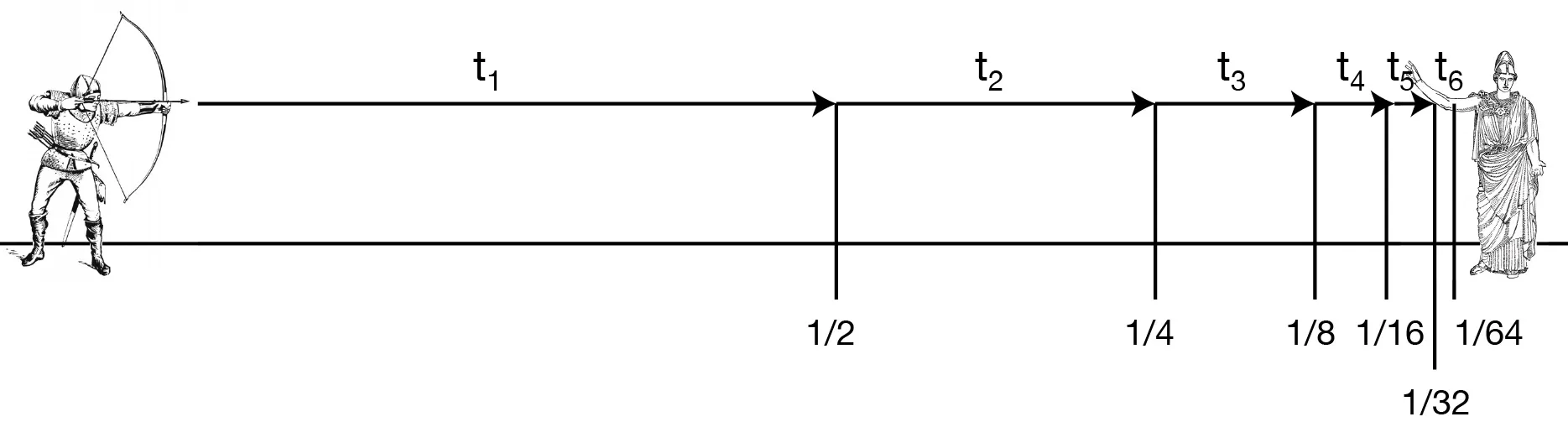
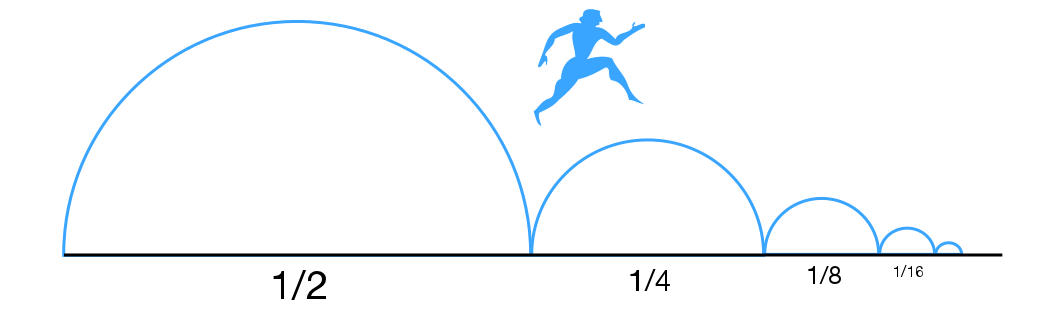
Image credits:
https://www.naturphilosophie.co.uk/zenos-paradoxes-or-what-happened-when-achilles-and-the-hare-decided-to-outfox-the-legendary-tortoise/
https://steve-patterson.com/defending-zenos-paradox/
https://www.naturphilosophie.co.uk/zenos-paradoxes-or-what-happened-when-achilles-and-the-hare-decided-to-outfox-the-legendary-tortoise/
https://steve-patterson.com/defending-zenos-paradox/
Both of these paradoxes rely on using infinity to "divide things into smaller and smaller elements". Since the path of the given object (arrow, Achelleis) is divided into smaller and smaller elements, there will always remain a portion for the object to travel. Thus Zeno concluded that since "infinite steps are used", it would be impossible for the object to reach the destination in a "finite time".
The paradox of "Achilles and the Tortoise" can be explored in the following applet.
(Shodor, 2024)
These paradoxes were resolved much later, using infinite series. In a geometric series, the sum of these infinite steps tends to 1. These will be discussed in the application portion of the site.
Reductio Ad Absurdum
Since they feared the concept, the Greeks did everything they could to avoid infinity and the idea of infinite limits. In order to do this, philosophers and mathematicians employed the "method of exhaustion" and conclusions of "reductio ad absurdum".
(Oppy, Graham, et al, 2021)
"Reductio ad absurdum" is a Latin phrase meaning "reduction to absurdity". These methods relied on comparison and contradictions to make conclusions. So while modern mathematicians would view such problems under the lens of infinite limits, the Greeks would avoid infinity by forcing contradictions and conclude with "and that is absurd, reductio ad absurdum".
Archimedes is one such Greek mathematician to employ the method of exhaustion and "reductio ad absurdum", as famously seen in the proof for his area of a circle. This proof is excellently depicted in (Casselman, 2003).
Development of Infinity and Calculus
Newton and Leibniz and other mathematicians throughout Europe (and the world) developed methods of calculus still used today. Calculus introduced the concept of limits, and "quantities that are infinitely small" - called infinitesimals.
(Rucker, 2020)
"The concept of infinity in calculus is closely tied to the idea of limits. For example, the sum of an infinite series can converge to a finite limit, a concept that would have been paradoxical to ancient thinkers. This new approach to infinity allowed for precise mathematical formulations and the solution of problems that had perplexed mathematicians for centuries."
(Chotaliya, 2015)
The first textbook of differential calculus was published in 1696 by the Marquis de L'Hôpital, which provided an "axiomatized structure" of calculus and foundations for modern methods of calculus and analysis. Some of these definitions and postulates found in the textbook will be presented in the mathematics section of this website. These definitions considered something the Greeks strove to avoid: "consideration of infinitely small quantities and the reduction of curves to infinilateral polygons".
(Oppy, Graham, et al, 2021)
Counting the Infinite and Cantor's Paradise
Across history and all discussions of infinity, two questions seem to stand out: How does one count from the finite to the infinite? Are there different sizes of infinity?
(Oppy, Graham, et al, 2021)
One of the earliest instances of mathematicians considering different sizes of infinity is with the Jain mathematicians of ancient India (circa 500 BC - 400 CE). These mathematicians "classified different types of infinities, recognizing that some infinities are larger than others - a precursor to the modern idea of comparing cardinalities".
(Chotaliya, 2015)
In the early 1820s, Bolzano had the idea that a set is infinite if there is a bijection between the set and a proper subset of it. In 1884, Dedekind assigned this idea to the definition of something being infinite.
(Oppy, Graham, et al, 2021)
"No one shall expel us from the paradise which Cantor created for us."
- David Hilbert
- David Hilbert
In the late 19th century, Georg Cantor's work on set theory introduced the concept of cardinality to compare sizes of infinite sets of numbers. "Cantor was able to show that infinity is not an all or nothing concept: there are degrees of infinity."
(Rucker, 2020)
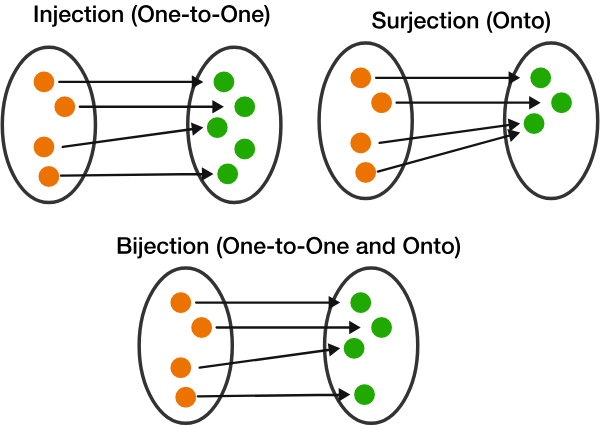
Image credit https://brilliant.org/wiki/bijection-injection-and-surjection/
Cantor established the "modern theory of infinities of counting" by introducing the concept of cardinality to compare sizes of infinite sets. Two sets have equal cardinality if there exists a bijection between two sets.
(Oppy, Graham, et al, 2021)
Bonus Meme