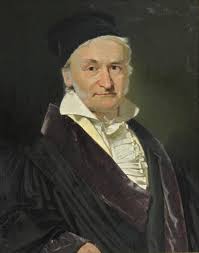
The ideas and notions of modular arithmetic existed well before they were formally defined. Old traditions in Chinese mathematics included problems that involved division and remainders. These problems were referred to as remainder problems (Bullynck, 2009). An example of this type of problem is: “There are an unknown number of things. Three by Three, two remain; five by five, three remain; seven by seven; two remain. How many things?” (Bullynck, 2009, p. 29). Different approaches and solutions to remainder problems attracted special interest in the 18th century. Today, the “Chinese Remainder Theorem” is considered the general rule for solving them (Bullynck, 2009). These ideas are what led to further development of modular arithmetic concepts. The modern approach and notation for modular arithmetic were developed by Carl Friedrich Gauss. At just seven years old, Gauss quickly recognized that the sum of integers from 1-100 was made up of 50 pairs of numbers each summing to 101, demonstrating his great potential to his teachers (O’Connor & Robertson, 1996). He has had many influential contributions to the fields of mathematics and physics. His work on modular arithmetic, published in 1801, was introduced in Disquisitions Arithmeticae, which contained seven sections devoted to number theory. (O’Connor & Robertson, 1996). He introduced the formal notation and his “…congruences, functioning as an equation, a relationship and a tool for abbreviating calculation, reshaped this fragmented field of mathematics (which had come from old algebra books, Rechnebücher, recreational mathematics, equation theory, and Diophantus) into a coherent theory” (Bullynck, 2009, p.68).