I'm going to be researching architecture and the math used in building
structures. I especially want to look into historical buildings, because those were built
using math and old tools, so I think it'll be pretty interesting, and incredible to see how precise
architects had to be with their math.
The seven wonders of the world: the Colosseum in Italy, Petra in Jordan, Chichen Itza in Mexico, Christ the Redeemer in Brazil, Machu Picchu in Peru, Taj Mahal in India and The Great Wall of China. These seven pieces of architecture are indeed some of the most impressive pieces of architecture in the world. Some are incredibly old and it is a wonder how the people in those times built such magnificent structures.
Architecture is deep in many mathematical concepts. Mathematics contributes to both the technical action of building, and the pleasing appearance of many architectural works. In these views there are many different mathematical concepts many of which could be dove into further.
Mathematics in architecture is a fairly broad topic, and there is a lot of pieces to architecture in which mathematics is used. This website will touch on many of these pieces as well as talk about some specific architectural wonders.
Background and History
The topic of this website was inspired by a PBS Nova documentary entitled The Great Cathedral Mystery. In this episode researchers worked to figure out how the dome of the cathedral Santa Maria del Fiore in Italy was built. This historic cathedral is famous for its massive dome, and in this PBS documentary the researchers find just how precise and mathematical the architects of that day had to be (PBS).
Architecture has been a part of human history for thousands of years. In fact, "the Neolithic period, roughly 10,000 years ago, could be considered the beginning of architecture" (Timeline). In those early periods we can envision architecture as something simpler, such as providing better shelter. However, as the years passed on architecture became more intricate and detailed, showing culture and beauty as well as functionality.
Building the Building
To begin, an architect does not just jump straight into putting bricks and stones together, an architectural structure often starts with a drawing.
Sketches for buildings have been used and are still being used to help architects and builders put all their ideas on a more easily editable surface. Here is a silly quote from one of my sources, "who wants to carry around a full-size drawing of a locomotive?" (Costin). Aside from a drawing being more easily editable than literal bricks, being able to draw what you want, but smaller makes it easier to transport, share, and see all the pieces come together to make a whole. Blueprints are drawn in such a way that the small image is exactly proportional to what the actual structure will look like. That means what is drawn is exactly how the real thing will look, just bigger. This accurate drawing is done with a mathematical concept called scaling.
Essentially, scaling is letting some unit represent another. For example, in a full scale drawing an inch on the paper would represent an inch on the structure. Another example, perhaps you want to draw a half-scale, half an inch on the paper will now represent a whole inch on the structure. By doing this, architects can draw smaller models of their vision without losing any accuracy.
Another mathematical building tool is geometry. Understanding geometry can be so significant in the drawing and building of structures. Understanding the qualities of a right triangle allows you to create simple tools that easily replicate right triangles anywhere. Some geometric shapes are stronger than others, some are more difficult to construct. The "triangle as a geometric shape is said to be the most stable and balanced shape, and for the same reason it is used as most reliable members of building when it comes to load bearing" (Aejaz). In order to make a structure that does its function appropriately, and is reasonable to construct it is important to understand these geometric qualities of different shapes.
For functionality of architecture, mathematics plays a large part in ensuring the structure works how it is supposed to and makes it more efficient to actually make the construction.
Pleasing to the Eye
There are lots of mathematical uses in the technical construction of architectural wonders, but you might be surprised at how much mathematics is used in making the unique looks of these structures.
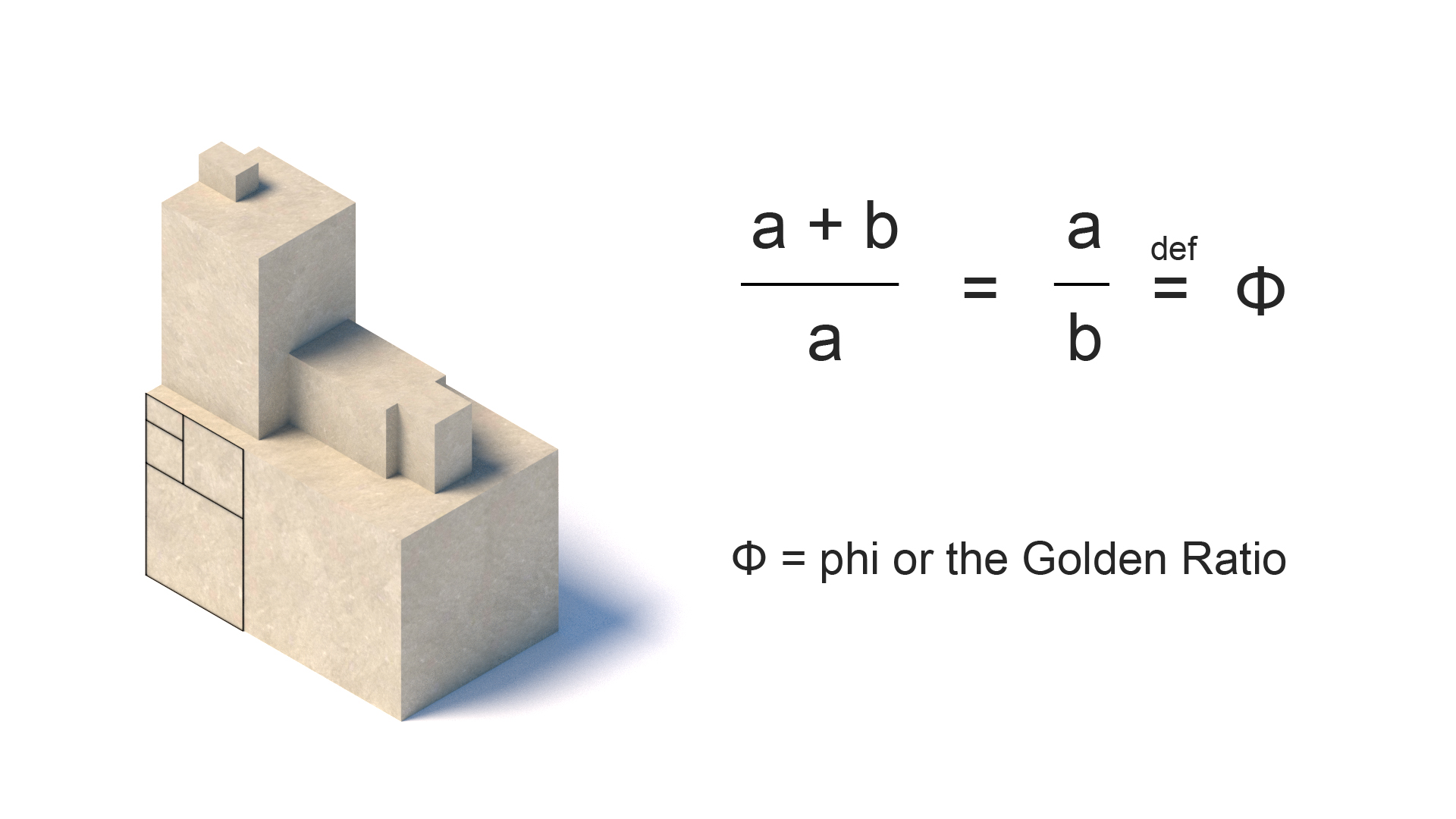
The golden ratio is quite an interesting topic and has a large influence in the designs of ancient structures. This curious number can be related to the Fibonacci sequence and is a naturally occurring phenomenon in nature. Because ancient people were able to find these mathematical representations of nature, the golden ratio and other similar numbers "[were] taken as a proof for the universe being designed by the Gods" (Erlendsson). With this religious view, many religious buildings would be constructed with such naturally occurring numbers and ratios. It is believed by many that the Egyptians and ancient Greeks used this divine number in the construction of the pyramids and pantheon (Aejaz)(Meisner). While these may not be one of the seven wonders of the world, both are still very significant and amazing pieces of architecture, and they stand as landmarks to the whole world.
Proportions and ratios in general play large roles in the pleasing appearance of architecture. In Islamic structures the use of equilateral triangles was significant in creating pleasing proportions throughout a whole structure. "The architects at Cordoba employed geometry to create a spatial web in which all parts are equal to each other and part of a single, unified space" (Arnold). In these designs of entire courtyards equilateral triangles were used for spacing, determining dimensions, and other such things. This allows an entire complex to be completely proportional and similar throughout all structures.
Symmetry! There are lots of different kinds of symmetry, and it is widely used in architectural design. Bilateral symmetry is probably the most familiar kind and is as easily recognizable as looking at a butterfly. Simply two halves mirror each other. "Chiral symmetry is found in two objects which are each other's mirror image and which cannot be superimposed, such as our hands" (Mazzini). Again, we are seeing nature being used in architectural designs. As well as mathematics. The natural world is full of mathematics, and people like to take inspiration from the natural world.
Significance and Application
Architecture is everywhere. It really is. Understanding the many mathematical uses of architecture allows a person to more fully appreciate the structure. Also, it’s important for the architects and builders to know the mathematics, so they can accurately create the fantastical structures that they do. Learning the history of mathematics in architecture is also really interesting. It is a wonder how ancient peoples were able to create such amazing things with the tools they had. Luckily, they had much of the mathematics we have today, and were able to use that.
As far as application goes. First and most obviously it is applied in real construction and designing architectural pieces. Second, many of the same mathematical concepts are useful in some cool building hobbies. For example, you have to understand scaling factors to read maps, as well as to build models. And if you’re really into woodworking, and building furniture or things like that, there are similar levels of mathematical concepts in that!
References
Arnold, F. (2018). Mathematics and the Islamic Architecture of Cordoba. Arts, 7(3), 35. https://doi.org/10.3390/arts7030035
Aejaz, Sana. (2023). The Importance And Applications Of Mathematics In Architecture. 10.13140/RG.2.2.19605.29923.
Costin, R. (n.d.). Scaling. Basic Blueprint Reading. https://openoregon.pressbooks.pub/blueprint/chapter/unit-4/
Erlendsson, G. (2021, August 7). 7 classical mathematics in Architecture. Thor Architects. https://www.thorarchitects.com/classical-mathematics/
Mazzini, V. Symmetry in Architecture.
Meisner, G. (2023, April 23). History of the Golden Ratio. The Golden Ratio: Phi, 1.618. https://www.goldennumber.net/golden-ratio-history/
Timeline of the history of Architecture. Urban Design lab. (2024, October 14). https://urbandesignlab.in/timeline-of-the-history-of-architecture/?srsltid=AfmBOopVyRaGOSvWn56JpCpdUA7Q5A6RyB1RVg7K9n5t7KCgmr6RKFAs
YouTube. (n.d.-a). Great Cathedral Mystery - PBS Nova - Documentary. YouTube. https://www.youtube.com/watch?v=E3LGWjel0r8