Explanation of Mathematics
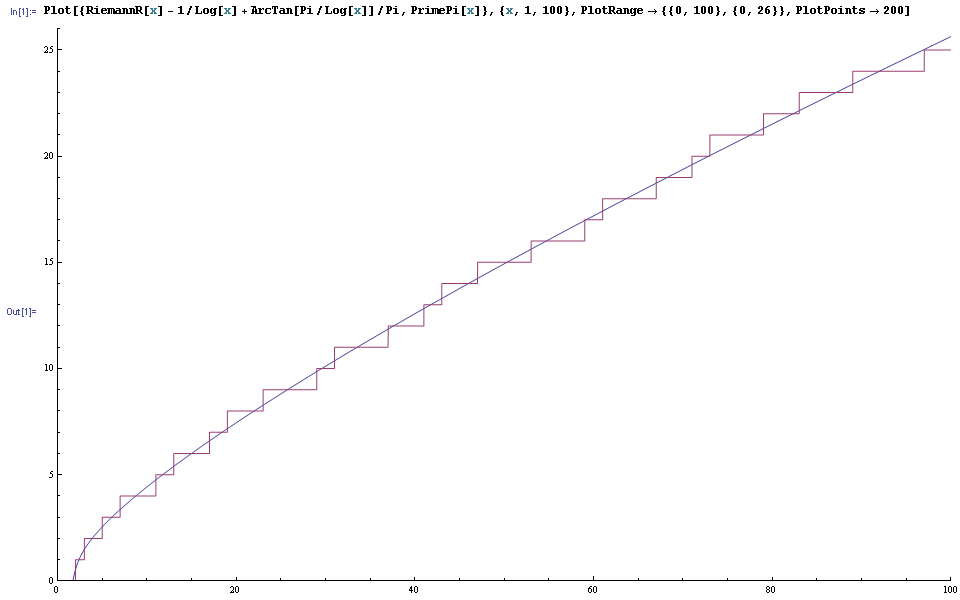
The journey continues with the Prime Counting Function, derived from Gauss's insights on prime numbers. Through a graph, we visualize how the function experiences a
distinct upward jump each time it encounters a prime number amidst an otherwise flat trajectory. Scaling up the graph unveils a smooth curve, leading Gauss to seek a
function with a similar graph. Simultaneously, he explores logarithmic functions, noticing the resemblance between the Prime Counting Function and the logarithmic
integral function. The slope of this function, 1 over log x, closely aligns with the Prime Counting Function.
Pioneering mathematician Leonhard Euler explores infinite series, revealing insights into convergence and divergence. His exploration leads to the discovery of the
Zeta function, expressed as an infinite product of series corresponding to prime numbers. Euler's findings hint at a profound connection between the Zeta function
and prime numbers. A century later, Bernhard Riemann extends the Zeta function to the complex plane through analytic continuation, making a breakthrough in prime
number theory.
Riemann's hypothesis, formulated in 1859, posits that all non-trivial zeros of the Zeta function align on a single vertical line, known as the critical line.
This hypothesis, pivotal in number theory, relates to the distribution of prime numbers. Riemann modifies Gauss's conjecture, involving Zeta zeros, aligning
it with the Prime Counting Function. While the Riemann hypothesis promises a deep understanding of prime number distribution, its rigorous proof remains elusive,
marking it as a million-dollar problem in mathematics.