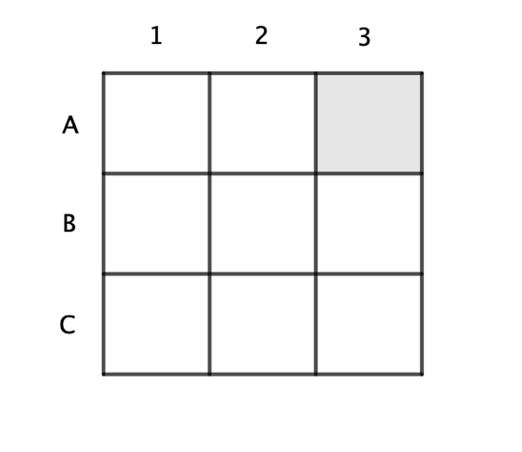
There are many different avenues to explore when examining the mathematical concepts within chess, so for simplicity, this article will focus on one
particular aspect rather than the mathematics of the game as a whole. Specifically, it will examine the problem of Rook Polynomials, this game is played
on a 3x3 board where a square on the board is crossed out and cannot be used. In his YouTube video “First Example of a Rook Polynomial,” Neil P. Strickland
walks viewers through the process of determining how many ways rooks can be placed on a board without attacking each other. In chess, a rook moves any number
of squares along a row or column, and it attacks any piece that lies along the same row or column—meaning it could capture that piece if it were an opponent.
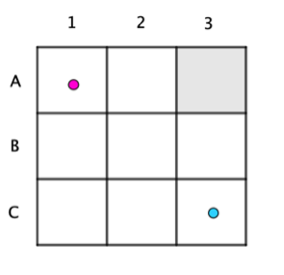
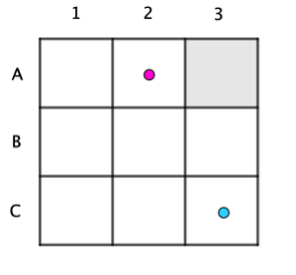
For this example, we will cross out the top right corner indicated by the grey square in the first figure shown below. The goal is to see how many possible ways
we can put various amounts of rooks on the board with them being non-attacking rooks (i.e. they never have the option of running into the other rooks).
1 Rook: At first, we will look at the board and think of how many possible places we can put 1 rook on the board. Since it is the only one on the board it can be
placed anywhere on the 8 squares, therefore there are 8 options.
2 Rooks: Now we will look at how many ways we can put two rooks on the board without them attacking each other. This gets a little bit more strategic so we will label
the rows as a, b and c and then we will label the columns 1, 2, and 3
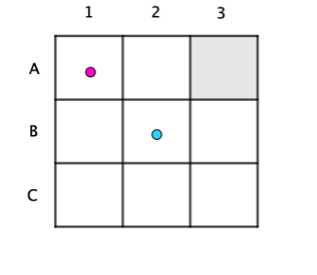
Now say we will put our first rook in the a1 position. Therefore, the second rook can be placed in one of the following four configurations, notably,
(a1,b2),(a1,b3),(a1,c2),(a1,c3)
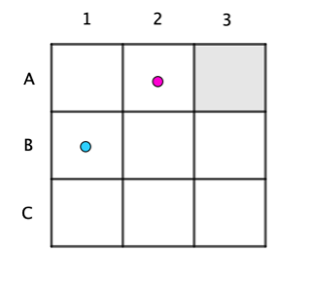
Now we will do the same thing but where our starting rook is on a2. Therefore, the possible positions for the second rook are,
(a2,b1),(a2,b3),(a2,c1),(a2,c3)
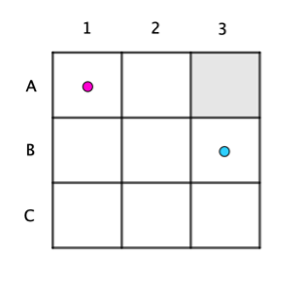
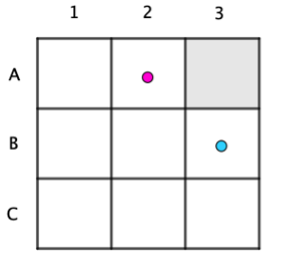
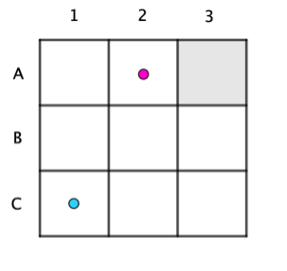
and so on and so forth. Repeating this for all of the different starting squares for our first rook, and not counting repeating elements we get all of the following options.
(a1,b2),(a1,b3),(a1,c2),(a1,c3),(a2,b1),(a2,b3),(a2,c1),(a2,c3)
(b1,c2),(b1,c3),(b2,c1),(b2,c3),(b3,c1),(b3,c2) = 14 total possibilities.
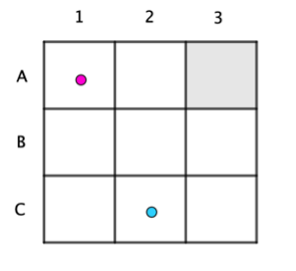
3 Rooks: Repeating the same process as above we get the following placement combinations.
0 Rooks: This is kind of an interesting way to think about it, but you don’t have to place any rooks anywhere therefore there is only one option and therefore one possibility.
Neil P. Strickland, in his academic paper “Rook Polynomials,” explains the process of condensing
information we know into a single expression. Using these numbers we have previously found; we will
summarize them by writing it in terms of a polynomial. We will notate that the board as B. Then we will
notate t as the number of rooks places on the board where the coefficients are the total possibility for
each number of rooks.
We know that for 0 rooks there was 1 possibility, for 1 rook there was 8 possibilities, for 2 rooks there were 14 possibilities and for 3 rooks there are 4 possibilities.
Therefore, we can write the polynomial as such:
rB(t) = 1 + 8t + 14t2 + 4t3
This gives us an equation that we can look at and immediately understand how many possible moves there are when we want to put a certain number of rooks on the chess board.