In my project, I will dive into the fascinating relationship between mathematics
and fashion design. Mathematics plays a huge role in creating functional and
attractive fashion, using things like geometric patterns, symmetry, and virtual models.
We can use this to further explain how these mathematical concepts influence patterns,
design choices, and the overall aesthetics of the fashion design industry.
Mathematics is nothing new to the world of fashion, as it has been utilized as a tool for development for many centuries. Early garments usually focused on proportion and geometry in the eyes of aesthetics and were often hand-constructed using body proportions and basic measurements. These early ways sparked an eye for creativity and a desire for efficiency in the production of garments. This is where we see the role of pattern making come into play.
Revolutionizing the system in garment construction, the “fashion pattern” system made its debut in the 19th century. These patterns were based on geometric principles for a more consistent and rapid rate of production. With this system came a pivotal change from handmade clothing to mass-produced items. Alongside this came a multitude of other mathematical challenges that were not initially expected. The industry now had to address the efficiency of material usage, the increased complexity of designs, and even an increase in demand.
With the use of patterns, came the use of deformable clothing. This idea was said to originate from a man named Chebyshev, who wanted to take woven fabrics and see them on a generic surface. This article explains beautifully what he does next, “Chebyshev developed a purely geometrical model where the fabric was idealized as a network of orthogonal inextensible fibres. Such a surface model was later referred to as Chebyshev net.” (Magri and Ciarletta 2023) This Chebyshev net was later used as a tool in developing future models for advanced fabrics, many of which are used in conjunction with the Chebyshev net.
We continue to see revolutionary technology develop along these lines. Recently, engineers have been able to optimize fabric cutting using mathematical principles, and designers have begun creating patterns out of advanced geometric transformations. To further aid in this, the creation of Computer-Aided Design (CAD) systems have now allowed designers to manipulate patterns in new ways. These online programs can allow for garments to be personalized, transformed, and made more intricately than ever before.
In more recent years, we have seen a push for a reduction of waste and a look to improve sustainability within the fashion industry. With the use of mathematical algorithms to increase optimization of cutting and 3-d modeling programs, some designers are even producing their own zero-waste fashion collections. As this may seem like an amazing idea in the long run, and although it may be feasible for many at home crafters, a study I found has shown why it is not applicable in the quick manufacturing world. According to their study, with the technology they were employing, they found that cutting fabric in a way to be “zero-waste” was ultimately more time consuming and translating 2-d patterns to 3-d form, “always provides inconsistent out-comes.”(ElShishtawy, N., Sinha, P., & Bennell, J. A. (2021))
Fun Resources
Explore various resources such as interactive tools, videos, and websites that can help you learn more about fashion design and mathematics in a fun and engaging way.
From the socks on your feet, to the dresses on the runway, every piece was expertly crafted with the hands of mathematics. Fashion designers utilize many tools to help them create their masterpieces, from 3-d printing, to tessellations, to the golden ratio, to Fibonacci numbers, and other mathematical softwares. Each tool has been researched, used, and is commonly found widely in the industry today.
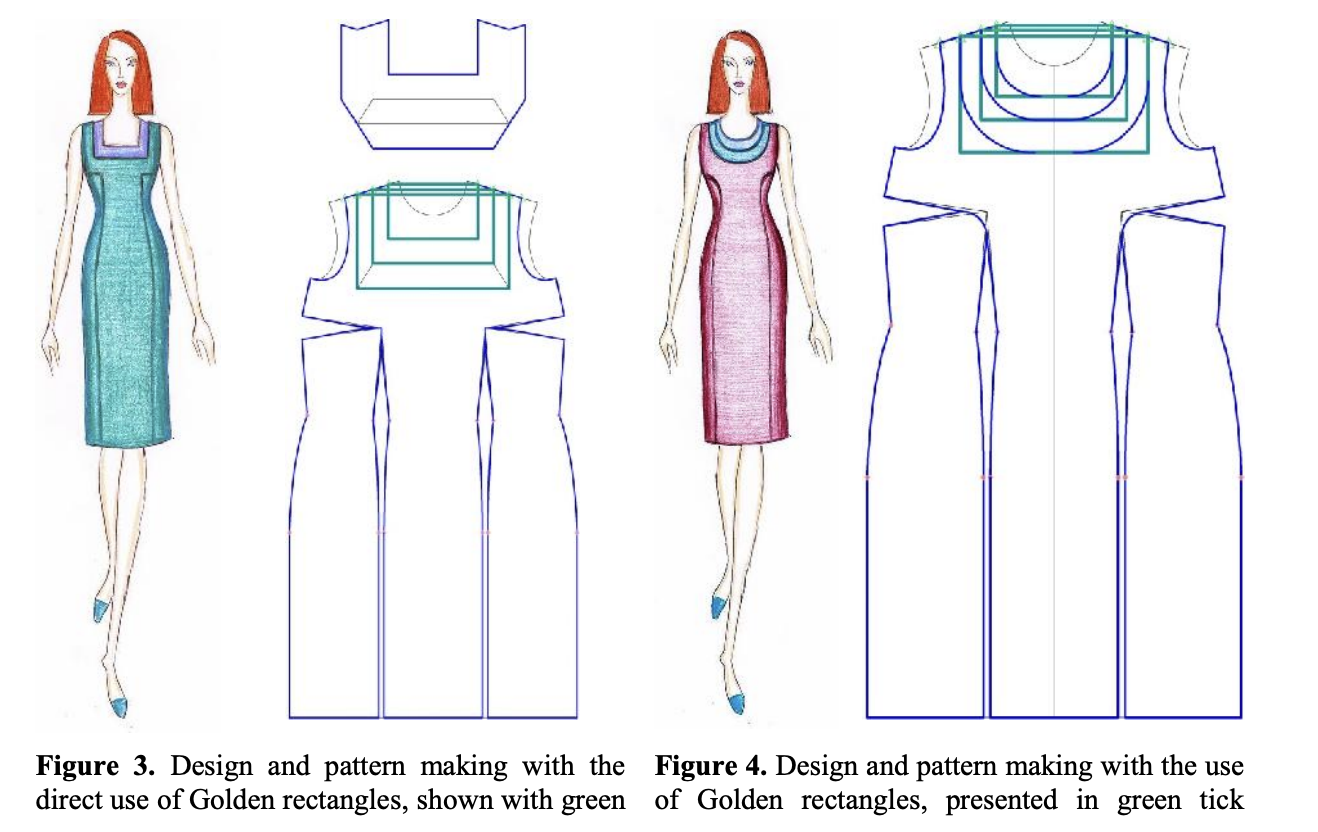
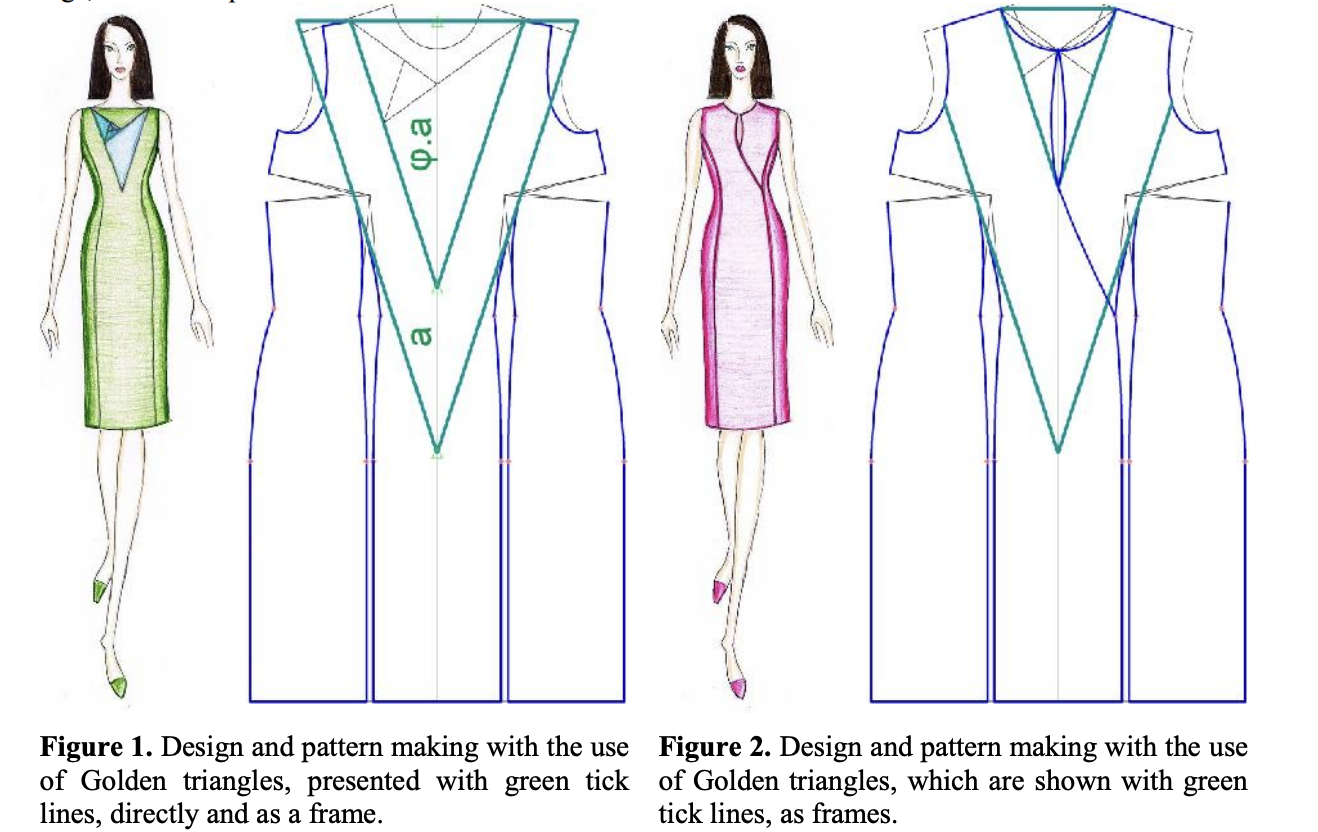
The Golden Ratio is something that is seen predominantly wherever you may look. But did you know that it is used in almost every single one of your clothing items as well? A dress that you may wear, its proportions are specifically thought out using golden triangles from the shoulders down. This can be utilized to create a “princess seam” or other specific cuts. Using golden rectangles will produce results of similar nature, but will provide other dress patterns. In creating equal tucks, or darts in your dresses, many designers will utilize the Fibonacci numbers to ensure consistency.
Look at these dresses that use this exact principle:
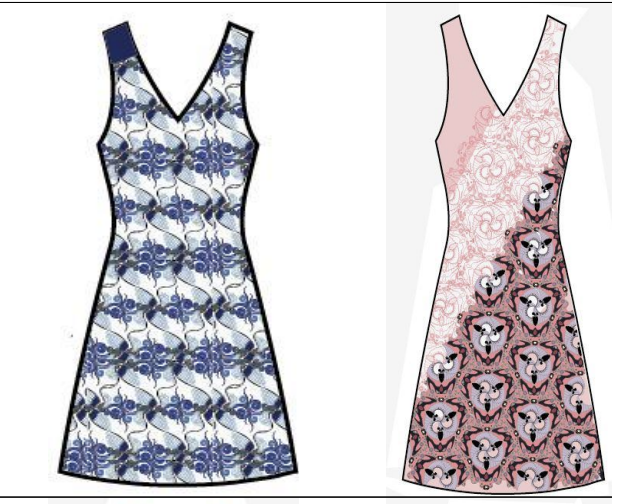
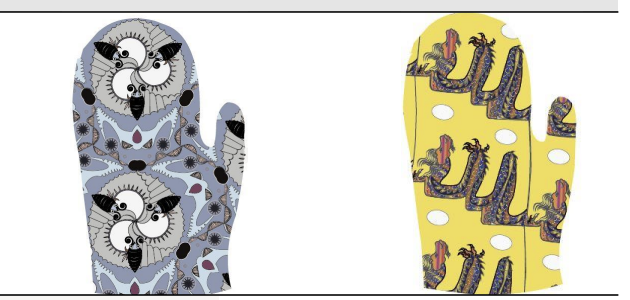
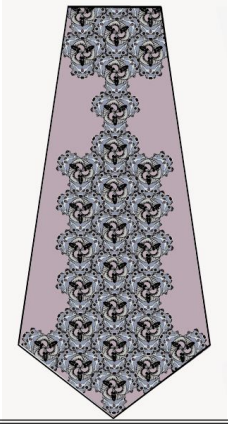
Designers also use tessellations to create fashion. Creating a pattern through the use of tessellations is no easy feat. A tessellation is a pattern created using shapes that completely fill a plane but do not overlap, and do not leave any empty space. The pattern must also be able to extend indefinitely, without fail. These are not shapes that can just be created without thought or care, as they must be specifically crafted to fit together using rotational and/or reflectional geometry. These patterns can be used to create all sorts of clothing or fashion items. The following images are from (https://koreascience.kr/article/JAKO201608967047911.pdf) where they used online mathematical software to their advantage to create tessellations and ultimately transfer those patterns into differnt clothing designs.
As mathematics has become a tool in the development towards fashion design aspects, it has also become a role in the aesthetics of the industry as well. As mentioned previously, tessellations are used as one instance, but other instances include 3-d geometry and additive modeling. This “math fashion” can take on the role of beautifully crafted works of clothing based on geometric principles using things like origami and scarves. Another role this industry leads is in additive modeling, where clothing items are adapted using 3-d printing techniques. This technique has already been adopted by large boot brands such as Timberland, using it in some of their midsoles.
The new mathematical technology doesn't stop at 3-d printing of different additions to clothing, we have started seeking further advancements. Currently, and looking towards the future in the industry, developers are working on a new technology in terms of smart textiles (a textile made with stimuli-responsive material). This new class of textiles is able to change aesthetic and functional properties as the response to different environmental conditions. The feedbacks that they had developed included: self-motion, temperature and moisture regulation, self-cleaning, and color change. These have later helped develop shape-shifting like clothes and gear used in different industries, as well as creating thermal-regulated fabrics that have helped in space expeditions.