 Celtic Knots:
History & Mathematics
Celtic Knots:
History & Mathematics
Celtic Knots:
History & Mathematics
Celtic Knots:
History & Mathematics
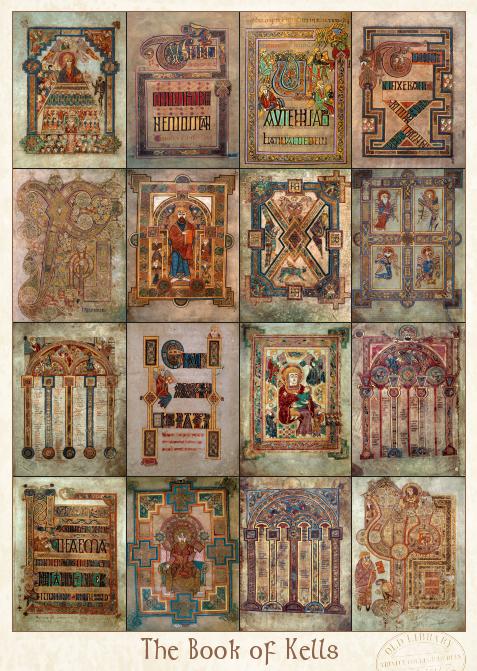
Did you know that every time you tie your shoes, you’re doing math? There is a topic within mathematics called Knot theory. Knot theory is the study of mathematical knots and has connections to other fields of mathematics such as topology and graph theory (Connor & Ward, 2012).Celtic knots are a type of intricate knot that have fascinated artists, mathematicians, and historians for centuries. They are also known as Gordian knots, which comes from an ancient Greek myth (Connor & Ward, 2012). It was said that the person who untied Gordius’ knot would rule all of Asia (Connor & Ward, 2012). Gaining prevalence in early medieval art, Celtic Knots are not only beautiful but also deeply symbolic as they hold significance within social and religious settings. They are found in ancient stone carvings and manuscripts such as the Book of Kells (Kific, 2022). Beyond their historical and artistic value, Celtic Knots offer a rich exploration in mathematics, specifically in knot theory, symmetry, and geometry.
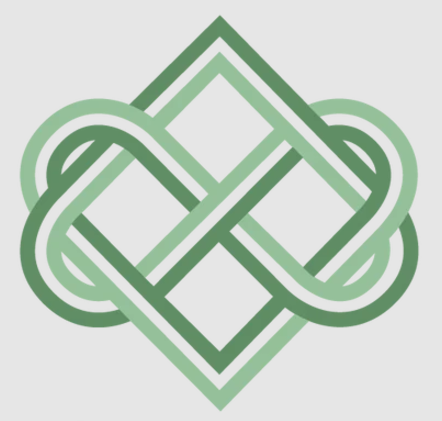
There are many different ways to define celtic knots. Deriving from ancient designs, they make up much of Celtic symbols (Kific, 2022). These knots have an interlaced pattern often characterized by looped designs without a definitive beginning or end (Kific, 2022). Additionally, they have been described as “stylized, interlaced patterns, representing ropes or threads tied in a knot” (Connor & Ward, 2012). Their geometric characteristics consist of repetitive patterns and symmetries (Gross & Tucker, 2010). Mathematically, the continuity of celtic knots implies they can be rearranged, but not untied (McLeay, 2011). In a topological sense, they can be described as link diagrams (Connor & Ward, 2012) with alternating links (Gross & Tucker, 2010).
As an art, the beginnings of celtic knots is a debated subject among historians. This may be due to the fact that it was common to have a tradition of oral history - so not much was written down (Kific, 2022). Celtic knots are closely tied to Irish, Scottish, and Welsh cultural identity. They have early appearances in illuminated manuscripts like the Book of Kells (circa 8th century). Celtic knots symbolize eternity, interconnectedness, and the cycle of life. Their beginnings can also be tied to Irish monks who used celtic knots as ornamentation for religious texts (Dunham, 2000). As Celtic art spread, it became adopted by different cultures. This caused regional changes in their designs, hence the reason Celtic knots found in Ireland, Italy, and Gaul are different in style and design (Kific, 2022).
The connection between math and celtic knots can be dated back to 1771 when knots were connected to geometry (Connor & Ward, 2012). Connecting mathematical concepts to knots was further developed by Gauss in 1833 (Connor & Ward, 2012). Knot theory became more popular when Sir William Thomson (Lord Kelvin) released a paper ‘On Vortex Atoms’ in 1867 (Connor & Ward, 2012). In this paper, Thomson discussed the idea that matter is composed of three dimensional knots (Connor & Ward, 2012). Thomson’s work allowed atoms to be classified by different knots corresponding to elements with specific chemical properties (Connor & Ward, 2012). In 1871, knot theory was almost forgotten when the Periodic Table of Elements was published (Connor & Ward, 2012). This was widely accepted by the scientific community, thus discrediting Thomson’s theory (Connor & Ward, 2012). The study of topology is what brought knot theory ideas back into relevance (Connor & Ward, 2012). As more studying went into knot theory, mathematicians were able to connect them to polynomials (Connor & Ward, 2012).
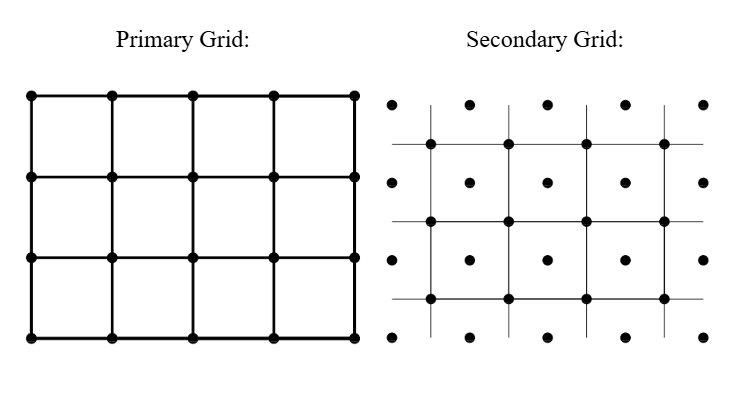
The construction of celtic knots is highly mathematical. Celtic Knots are often created through the use of grids. Additionally, there are many different methods of creating said grids. One method begins with what can be called the primary grid (Dunham, 2000). The center points of the squares form the vertices of the secondary grid (Dunham, 2000). Something interesting to note is that if you begin with a rectangular grid of size mn, the secondary grid will have mn+(m-1)(n-1) points (Richeson, 2023).
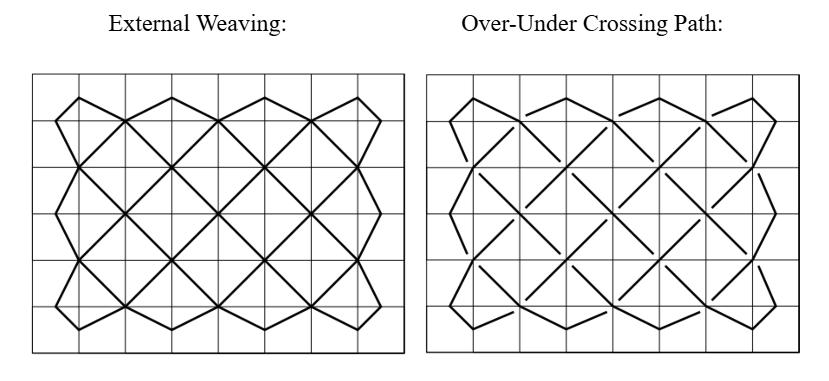
The combining of the primary and secondary grids creates what’s called the tertiary grid (Dunham, 2000). The squares in the tertiary grid are half the size of the squares in the primary and secondary grids (Dunham, 2000). The interior diagonals of the tertiary grid will help form the internal weaving of the celtic knot (Dunham, 2000).
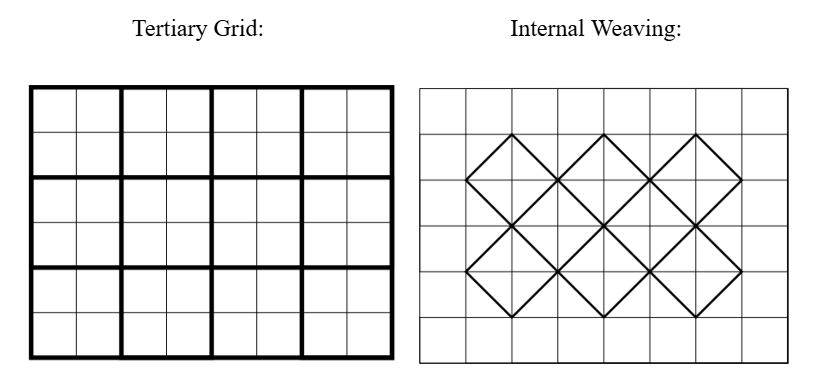
The exterior weaving is created by connecting the ends of the internal weaving (Dunham, 2000). You can then alternate the over-under crossing to create the path for the knot (Dunham, 2000).
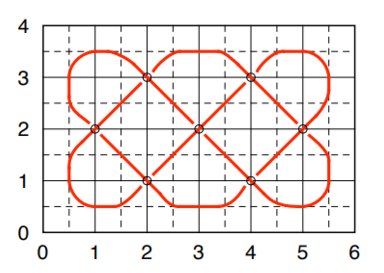
Another method begins with a rectangular grid with dimensions $2m \times 2n$ where $m$ and $n$ are positive integers (Gross & Tucker, 2010). You would then place a lattice point at $(x,y)$ such that $x+y$ is odd (Gross & Tucker, 2010). These lattice points will be the intersection points for the celtic knot (Gross & Tucker, 2010). If the $x$ value of the lattice point is odd, the direction of the overcross will be southwest to northeast (Gross & Tucker, 2010). If the $x$ value is even, the overcross will go from northwest to southeast (Gross & Tucker, 2010). The border is then created by connecting all the line segments (Gross & Tucker, 2010). The resulting knot is as follows:
A unique celtic knot can be created by using both of the methods discussed above. Beginning with a primary grid on an $x-y$ plane, the secondary grid is created through every other point on the primary grid (Mackinnon, 2018). Refer to this photo:
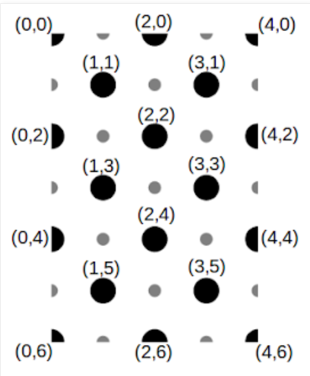
Where the primary grid is gray and the secondary grid is black. The boundaries can be created by connecting any two non-diagonal, adjacent secondary points as long as there is not more than one boundary crossing through a primary point (Mackinnon, 2018). An example of such boundaries is shown:
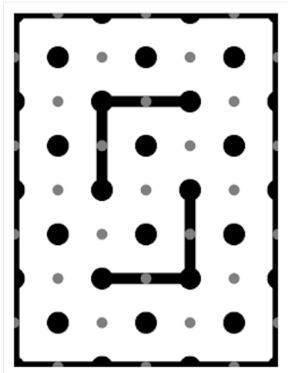
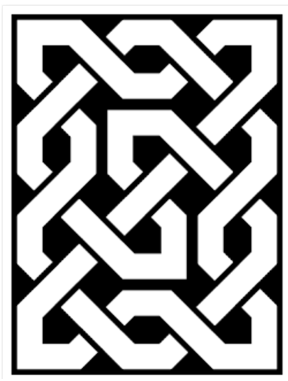
You can then follow the even and odd $x$-value overcrossing rules mentioned above to get the alternating crosses for the knot (Mackinnon, 2018). With the boundary examples shown above, we get the following celtic knot:
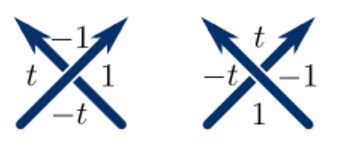
The Alexander Matrix has rows corresponding to the crossings and columns corresponding to the knot regions (Connor & Ward, 2012). It is an $n$ $(n+2)$ matrix where n is the number of crossings the knot has (Connor & Ward, 2012). “The $ij^{th}$ entry is appropriate value from $\{1,-1,t,-t\}$ where the $i^{th}$ crossing meets the $j^{th}$ region” (Connor & Ward, 2012). The $ij^{th}$ entry will be zero if the region does not touch a crossing (Connor & Ward, 2012). By reducing the matrix, finding the determinant, and factoring out the largest power of $t$, you obtain a polynomial that represents the celtic knot (Connor & Ward, 2012).
Now that we’ve gone over what celtic knots are, where they came from, and their connection to mathematics, let’s discuss why this is important. Knots have applications in many real-world contexts. For example, knot theory has led to many discoveries in regards to DNA. DNA can become knotted which influences its function within a cell (Connor & Ward, 2012). Knot theory can also be applied in the context of pharmaceuticals. Since understanding knots can aid in the understanding of a molecule's function, knot theory can be used to study the chirality of drug molecules. Consequently, scientists can create drugs that fulfill their purpose rather than having detrimental side effects (Connor & Ward, 2012). Knot theory also has applications within the scientific fields of statistical mechanics, quantum physics, and gravitational physics (Connor & Ward, 2012).
Aside from knots’ application in scientific fields, celtic knots are seen all over the world. Celtic knots have deep symbolism that can be portrayed in many different art forms. Jewelry and tattoos, for example, can have celtic designs with meaningful implications many individuals choose to carry on their person. A married couple might choose to have a celtic love knot on their wedding bands. A celtic knot tattoo may be representative of an individual’s culture. Wherever celtic knots may be seen, they are another representation of the ever present connection between mathematics and art.
Connor, J., & Ward, N. (2012). Celtic Knot Theory. The University of Edinburgh. https://www.maths.ed.ac.uk/~v1ranick/knots/celtic.pdf
Dunham, D. (2000). Hyperbolic Celtic Knot Patterns. University of Minnesota Duluth. Retrieved November 13, 2024, from https://nguyen.univ-tln.fr/share/IHM/celtic_dunham.pdf
Gross, J. L., & Tucker, T. W. (2010, March 11). A Celtic Framework for Knots and Links. CS@Columbia. Retrieved November 13, 2024, from http://www.cs.columbia.edu/~gross/research/CeltFrameGT-DCG.pdf
Kific, A. (2022, August 22). Celtic Knot - The History and Symbolism Behind Celtic Knots. Art in Context. Retrieved November 13, 2024, from https://artincontext.org/celtic-knot/
Mackinnon, D. (2018, November 29). algorithms for drawing celtic knots. mathrecreation. Retrieved November 13, 2024, from https://www.mathrecreation.com/2018/11/algorithms-for-drawing-celtic-knots.html
McLeay, H. (2011, 01 02). Links and Knots. NRICH. https://nrich.maths.org/articles/links-and-knots
Richeson, D. (2023, October 11). Drawing a Celtic Knot – David Richeson: Division by Zero. David Richeson. Retrieved November 13, 2024, from https://divisbyzero.com/2023/10/11/drawing-a-celtic-knot/
Wackrill, P. (2006). Celtic Knotwork and Knot Theory. The Bridges Archive. https://archive.bridgesmathart.org/2006/bridges2006-521.pdf