Embark on a mathematical exploration into the realm of Riemann sums, a fundamental concept in calculus that serves as
a bridge between the discrete and continuous worlds. Originating from the brilliant mind of the 19th-century mathematician
Bernhard Riemann, these sums offer a powerful tool for approximating definite integrals and understanding the intricacies of
continuous functions. Imagine the challenge of measuring the area under a curve when traditional methods fall short - Riemann sums
come to the rescue, breaking down complex shapes into simpler components. As we delve into the nuances of this mathematical technique,
we unravel not only the elegance of approximation but also the profound connections between discrete summation and the continuous
nature of calculus. Join us on this journey as we decode the language of rectangles and unveil the beauty of Riemann sums in
illuminating the profound depths of mathematical analysis.
In the collections of mathematical history, Riemann sums emerge as a pivotal concept. Named after the visionary German
mathematician Bernhard Riemann, Riemann sums originated in the mid-19th century, where Riemann introduced these sums as a groundbreaking
approach to understanding the behavior of functions and their integration. Motivated by the challenge of quantifying
the area under curves with irregular shapes, Riemann devised a method that involved partitioning an interval into
subintervals and approximating the function's behavior within each. This revolutionary technique not only laid the
foundation for modern calculus but also offered a profound connection between discrete and continuous mathematics.
Riemann sums became a cornerstone in the development of integral calculus, providing a systematic way to grasp the
essence of functions, paving the way for further mathematical innovations and applications across various disciplines.
The legacy of Riemann sums endures as an indispensable tool, illustrating the ingenious ways mathematicians have sought
to comprehend the complexities of the mathematical universe.
Explanation
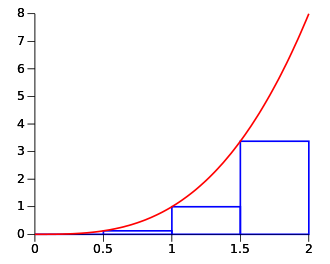
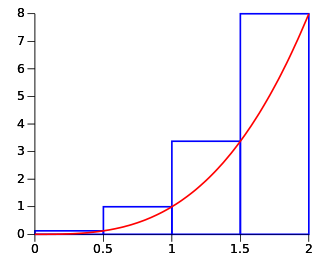
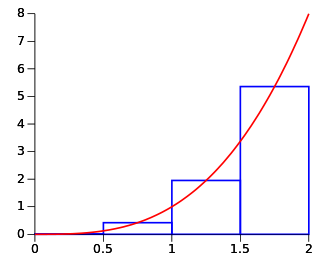
At its mathematical core, Riemann sums constitute a methodical approach to approximating the definite integral of
a function over a specified interval. The process involves dividing the interval into numerous subintervals,
each characterized by a width denoted as Δ x. Within each subinterval, a representative sample point is chosen, and
the function's value at that point is then multiplied by the subinterval width. The sum of these products across all
subintervals yields the Riemann sum. This procedure allows us to conceptualize the accumulation of quantities - such as
area under a curve - by taking a limit as the number of subintervals approaches infinity and the width approaches zero.
Beyond its fundamental role in integral calculus, Riemann sums establish crucial connections with other mathematical
concepts. They exemplify the convergence of discrete and continuous realms, forging a profound link between
differential and integral calculus. The representation of Riemann sums serves as a foundation for understanding more
advanced topics, including the development of definite integrals, the Fundamental Theorem of Calculus, and applications
in areas like physics and economics. As rectangles approximate areas, Riemann sums stand as a versatile tool, offering
insights into the intricate relationships inherent in mathematical analysis and providing a gateway to deeper exploration
within the broader landscape of calculus. There are many different representations of Riemann sums with the most notable being
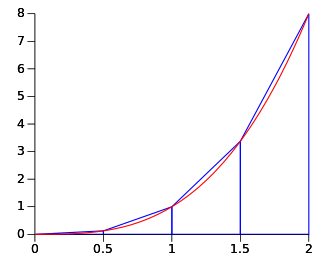
left, right, and midpoint Riemann sums. However, it should be noted, that other representation that can be used are the trapezoidal
Riemann sum, the random Riemann sum, and the lower Darboux and upper Darboux Riemann sums. There are even different ways to use
weighted averages mixed with Riemann sums to approximate the area. These increase in complexity and are usually referred to as Simpson's rule
and Newton-Cotes formulas.
The main focus of this project is to help introduce people to the different representations of Riemann sums and to help
them use some of the representations that aren't as utilized such as the random Riemann sum. Random Riemann sums are a mathematical
concept used in calculus to approximate the integral of a function over a specified interval. Unlike regular Riemann sums, where
the subintervals are equally spaced, random Riemann sums allow for irregularly sized subintervals. This approach enables a more
flexible and nuanced estimation of the integral, making it particularly useful in scenarios where the function being integrated
exhibits varying behavior over the interval. By randomly selecting subintervals, one can capture the intricate details of a
function's behavior and obtain a more accurate approximation of the integral. Random Riemann sums are a valuable tool in numerical
analysis and are often employed in computational mathematics to tackle complex problems with a high degree of precision.
Access Code: BZ842V
My Riemann Sum Applet:
Significance
Riemann sums, despite their seemingly abstract mathematical origins, hold profound significance in the real world.
These sums offer a practical means of approximating complex quantities, making them indispensable in various fields such as physics,
engineering, economics, and computer science. In physics, they aid in calculating the motion of objects, determining work done,
or predicting material properties. Engineers use Riemann sums to analyze systems, whether for structural design or fluid dynamics.
In economics, they help model and evaluate trends and scenarios. Additionally, computer scientists employ Riemann sums in numerical
algorithms for tasks ranging from image processing to simulating physical phenomena. These sums provide a tangible connection between
the abstract realms of calculus and the concrete challenges of real-world problem-solving, underlining their enduring importance
across diverse domains. Riemann sums can be applied to a variety of different fields in the real world, with some of these being Calculating Areas and Volumes,
Physics and Engineering, Economics, Probability and Statistics, Environmental Science, Computer Graphics, Finance, Geographic Information Systems,
Medicine and Pharmacokinetics, and Machine Learning and Data Analysis. There are other ways that Riemann sums can be applied to real life situations; however,
the ones listed previously are the most common. If any of the above fields above interest you, it would be recommended to research how Riemann
sums are used in that field.
☆ For more on random Riemann sums, you can access an applet
by clicking here.
This applet allows you to graph various functions and then find the approximation using various different representations of Riemann sums. This applet also allows you to look at the random Riemann sum in more detail. ☆
Additional Applet
bottom
References
Boelkins, M., Austin, D., & Schlicker, S. (2022, April 4). 4.2: Riemann sums. Mathematics LibreTexts. https://math.libretexts.org/Under_Construction/Purgatory/Book%3A_Active_Calculus_(Boelkins_et_al.)/04%3A_The_Definite_Integral/4.02%3A_Riemann_Sums
Calculus early Transcendentals: Integral & multi-variable calculus for Social Sciences. Riemann Sums. (n.d.). https://www.sfu.ca/math-coursenotes/Math%20158%20Course%20Notes/sec_riemann.html
Hartman, G. (2020, December 21). 5.3: Riemann sums. Mathematics LibreTexts. https://math.libretexts.org/Bookshelves/Calculus/Calculus_3e_(Apex)/05%3A_Integration/5.03%3A_Riemann_Sums
Incognito, A. (n.d.). 4.4 riemann sums. Ximera. https://ximera.osu.edu/math/calc1Book/calcBook/riemannSums/riemannSums
Nykamp DQ, “Calculating the area under a curve using Riemann sums.” From Math Insight. http://mathinsight.org/calculating_area_under_curve_riemann_sums
Raveendran, B., & Gokulnath, D. (2019, September 16). Riemann integral-definition, formulas and applications. BYJUS. https://byjus.com/maths/riemann-integral/#:~:text=It%20is%20also%20used%20for,area%20under%20the%20given%20curve
Riemann sum. DBpedia. (n.d.). https://dbpedia.org/page/Riemann_sum#:~:text=In%20mathematics%2C%20a%20Riemann%20sum,of%20curves%20and%20other%20approximations.
Ryan, M., Glonek, G., Tuke, J. et al. Capturing functional connectomics using Riemannian partial least squares. Sci Rep 13, 17386 (2023). https://doi.org/10.1038/s41598-023-44687-2
Sharma, G., C., S., & Plaza, J. (n.d.). Riemann sums. Brilliant Math & Science Wiki. https://brilliant.org/wiki/riemann-sums/
Urmeneta, H., & Hernández, V. (2007). Random riemann sum estimator versus Monte Carlo. Computational Statistics & Data Analysis, 51(9), 4717–4730. https://doi.org/10.1016/j.csda.2006.09.041
Wikimedia Foundation. (2023, September 25). Riemann sum. Wikipedia. https://en.wikipedia.org/wiki/Riemann_sum